Sunday, January 9, 2022

Mispornouncing Students' Names: A Slight That Can Cut Deep


 From: https://www.edweek.org/leadership/mispronouncing-students-names-a-slight-that-can-cut-deep/2016/05?utm_source=fb&utm_medium=soc&utm_campaign=edit&fbclid=IwAR22va0KvWXARZSBRHtNcKTxvoyJOElmRWAi2YQWRlBKQJJpZnTqHu4C8cw

Mispronouncing Students’ Names: A Slight That Can Cut Deep

By Corey Mitchell — May 10, 2016  7 min read

When people come across Michelle-Thuy Ngoc Duong’s name, they often see a stumbling block bound to trip up their tongues.

The 17-year-old sees a bridge.

A bridge spanning her parents’ journey from Vietnam to the United States.

A bridge connecting the U.S.-born teen to Vietnamese culture.

A bridge to understanding.

“My name is where I come from,” Michelle-Thuy Ngoc said. “It’s a reminder of hope.”

A junior at Downtown College Prep Alum Rock High School, a San Jose, Calif.-based charter school, Michelle-Thuy Ngoc (Michelle knock twee) is among the students backing “My Name, My Identity,” a national campaign that places a premium on pronouncing students’ names correctly and valuing diversity.

The campaign—a partnership between the National Association for Bilingual Education, the Santa Clara, Calif., County Office of Education, and the California Association for Bilingual Education—focuses on the fact that a name is more than just a name: It’s one of the first things children recognize, one of the first words they learn to say, it’s how the world identifies them.

For students, especially the children of immigrants or those who are English-language learners, a teacher who knows their name and can pronounce it correctly signals respect and marks a critical step in helping them adjust to school.

But for many ELLs, a mispronounced name is often the first of many slights they experience in classrooms; they’re already unlikely to see educators who are like them, teachers who speak their language, or a curriculum that reflects their culture.

“If they’re encountering teachers who are not taking the time to learn their name or don’t validate who they are, it starts to create this wall,” said Rita (ree-the) Kohli, an assistant professor in the graduate school of education at the University of California, Riverside.

It can also hinder academic progress.

A divide already exists between many English-learners and immigrant students and their native-English speaking peers. Despite a national increase in the overall graduation rate, the dropout rate for foreign-born and immigrant students remains above 30 percent, three times that of U.S.-born white students.

Before transitioning into K-12 administration, Santa Clara County Superintendent Jon Gundry taught middle and high school English-as-a-second-language classes for 16 years. Many of his students were newcomer English-learners and he made it a priority to learn the proper pronunciation of each student’s name on the first day of class.

“I was their first connection to a new culture, a new country,” Gundry said. “As a teacher, I felt that if I didn’t make an effort to pronounce their name correctly, it showed I didn’t care about who they were.”

Rendered Invisible

Effort is the biggest obstacle to learning how to correctly pronounce a person’s name; teachers have to want to do it, said Jennifer Gonzalez, a former teacher and author of the education blog Cult of Pedagogy. To even suggest that a child’s name is difficult to pronounce is problematic, she said.

Junior Michelle-Thuy Ngoc Duong poses for a photograph at Downtown College Prep Alum Rock in San Jose, Calif.

“Even the word ‘difficult’ is a pretty loaded word,” Gonzalez said. “It’s only difficult because it’s culturally different.”

As a kindergarten student in 1950s Brooklyn, Carmen Fariña, a native-Spanish speaker, had a teacher who marked her absent every day for weeks because she didn’t raise her hand during roll call. The teacher assumed Fariña was being defiant, but the future New York City schools chancellor never heard her name called; the teacher had repeatedly failed to pronounce it correctly, including rolling the r’s.

“Mispronouncing a student’s name essentially renders that student invisible,” Fariña said during a keynote address at the National Association for Bilingual Education annual conference in March.

Kohli produced a study with Daniel Solórzano, a professor of education and Chicano studies at the University of California, Los Angeles, on microaggressions, the subtle slights that are painfully obvious and hurtful to the person receiving them, but unintended and unnoticed by the person saying them. The work, “Teachers Please Learn Our Names! Racial Microaggressions and the K-12 Classroom,” is littered with stories of students who endured shame, anxiety, or embarrassment, and sometimes a mix of all three, when their names were called in class.

There’s the tale of a Portland, Ore.-area student with a traditional Chinese name who had her name garbled by a vice principal during an honors ceremony. Set to present the student with an award, the principal laughed at his mistake, drawing chuckles from the audience.
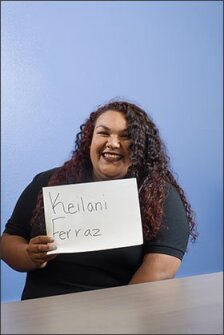
Sophomore Keilani Ferraz poses for a photograph at Downtown College Preparatory Alum Rock in San Jose.

To avoid embarrassment, the student slumped in her seat, refusing to rise to receive the prestigious award. She later skipped her graduation.

The mispronunciation wasn’t an isolated event. Having endured years of slights, she felt the need to become invisible long before the principal’s laughter marked the tipping point.

The woman, who went on to become an educator, changed her first name to ‘Anita.’

“If someone mispronounces your name once as a high school student, you might correct them,” said Kohli, whose parents immigrated to the United States from India. “But if this has been your entire existence in education, what do you do?”

Kohli’s own brother had a teacher mispronounce his traditional South Asian name, Sharad (shu-rudth) as Sharub during a 9th grade class. The teacher and the students decided it was easier to call him Shrub, and it stuck for the rest of high school. The nickname forced him to check part of his identity at the door.

Michelle-Thuy Ngoc didn’t always embrace her full name, figuring that it would make other people uncomfortable. For years, she ignored the Vietnamese half of her first name, simply going by Michelle. The order in which Vietnamese names are spoken differs from English.

“I came to accept [my full name] over time,” she said.

Freshman Francis Alecz Deloso poses for a photograph at Downtown College Preparatory Alum Rock in San Jose.

Building Bridges

If students have teachers who share their cultural backgrounds, they’re more likely to hear their names pronounced correctly. But while the diversity of the nation’s public school student body has exploded in the last few decades, the number of African-American, Latino, and Asian teachers hasn’t kept pace.

Gonzalez, a former teacher in school districts in Kentucky and Maryland, said she often observed a ‘these people’ attitude from her mostly white female colleagues.

“They approached it like ‘It’s your fault for having a weird name,’” Gonzalez said.

To some degree, Gonzalez understands the struggle students face. She grew up with a Russian surname, Yurkosky, that befuddled teachers and classmates. She said it rhymes with “her-pots-ski,” minus the “t” sound in pots.

“But I did not experience all the other stuff and other ways that a person can feel discriminated against,” said Gonzalez, who is white.

Kohli, a former Oakland Unified School District teacher, recommends that K-12 educators identify and expand their cultural limits and recognize the influence they wield over a student’s sense of self. While frustration or confusion may seem like a natural response when a teacher faces an unfamiliar name, it can leave a “lasting impact on the way that child sees themselves and their culture,” the study’s authors argue.

Butchered names are not just a problem for English-learners and immigrants; students from a number of cultural backgrounds have their names garbled or ridiculed. Hawaiian and African-American students, with names that link to their ancestry, also shared stories of how constant mispronunciations made them feel uncomfortable with their names.

Mocking Names?

In an extreme case, a teacher in Wayne Township, N.J. lost her tenure status and job in 2015 for mocking a student’s name on Facebook. Several letters in the student’s name spelled out a profane word, legal documents show.

More often, the mocking is more direct and reflexive: laughing off pronunciation, asking the student to take on a nickname, or making a spectacle of their name, Kohli said.

Sophomore Kashmir Perez poses for a photograph at Downtown College Preparatory Alum Rock in San Jose.

“It matters what you do when you’re in front of a child and struggling with their name,” Kohli said. “Is it framed as my inability to say someone’s name or is it framed as the student doing something to make your life more difficult?”

Michelle-Thuy Ngoc attends Downtown College Prep, a 210-student high school that primarily serves first generation, low-income Latino students.

“We’re taking the time to understand each person’s story,” said assistant principal Moises Buhain. “It’s as simple as starting with a name.”

As part of a social media campaign, the “My Name, My Identity” initiative is seeking name stories with the #mynamemyid hashtag. The push is personal for Yee Wan, the national association’s president and the director of multilingual education services for the Santa Clara County, Calif., office of education.

Wan came to the United States as an adolescent English-learner, and almost immediately faced pressure from instructors to adopt an “American name” to replace her given name, which means “warm friendship” in Cantonese.

Gundry and Wan developed “My Name My Identity” after hearing a principal share a story about his effort to build connections with English-language learners in school, then feeling the push fall flat when he mispronounced the students’ names at graduation.

“As educators, we have the power to bring awareness to valuing diversity ... so that all of our students will feel included,” Wan said.


EDUTOPIA: A MORE EQUITABLE (AND ENGAGING) WAY TO TEACH WRITING IN ELEMENTARY SCHOOL


LITERACY

A More Equitable (and Engaging) Way to Teach Writing in Elementary School

When teachers tie writing instruction to what students are reading, learners begin with a more level playing field.

January 6, 2022
Elementary students writing in classroom
Ridofranz / iStock

“I don’t know what to write about.” This was the sentence I most dreaded and, unfortunately, heard too often in the classroom.

For some time, like many elementary school teachers, I taught writing in a way that invariably led to that response from my students, which made me think there had to be a better approach.

At the time, I used a common instructional approach that emphasized sentence structure, grammar, vocabulary, and spelling—but didn’t spark joy in writing, connect it to what we were reading, or build knowledge on important topics. Skills were taught as stand-alone topics, devoid of meaningful content.

During a typical writing block, I’d give students a prompt like “Write about a small moment in your life or something that took place over the weekend.”

I taught in a diverse school in Washington, D.C., and for some of my students, the question was easy. They might write about a museum visit, a day at the beach, or an outing with their dog. But for other students, often those from low-income families, the question failed to elicit comparable answers. Instead, it simply highlighted inequities among my students and led to gaps in their performance.

BUILDING KNOWLEDGE AND SKILLS

I eventually became an assistant principal, but the problem stuck with me and continued to trouble my teaching colleagues. We knew there had to be a better way, and together we began doing some research. We looked into knowledge-building curricula—materials that help students learn about important topics while developing critical skills at the same time. Research shows that increasing students’ background knowledge on important topics supports their understanding of texts and ability to absorb and retain information.

So, with a literacy approach that explicitly emphasizes the development of knowledge and skills, writing and reading lessons are deeply intertwined, rather than being taught as two separate and disconnected blocks. Writing assignments are rooted in the texts that students are reading, and texts connect important topics like history, science, or art.

I’m grateful that my school went on to adopt this kind of knowledge-building approach. What a difference it made. To give you a sense of the change, in a fourth-grade class, students studied the American Revolution and read engaging, complex texts, like Liberty! How the Revolutionary War Began and excerpts from A Young People’s History of the United States. They enthusiastically participated in thoughtful discussions on what they read and dove into related writing assignments; for example, they took the perspective of someone who lived in the period and wrote an essay on whether the colonists were or were not justified in declaring independence from Britain.

The result? Over time, our learners improved in literacy. We saw improvements in the quantity and quality of student writing. The experience they gained in answering text-based questions and supporting their work with text evidence also helped prepare them for standardized tests. We used rubrics to measure growth, and we took notes on how students responded to writing tasks and monitored and recorded their progress.

Specifically, we saw growth in students’ use of academic vocabulary in both speaking and writing. For example, when studying a unit on food, students became adept at using words like esophagus, intestine, and villi. They were also able to answer more in-depth questions and apply their deeper knowledge to their writing.

Anecdotally, we saw that they were more eager and excited to write, and their confidence grew. Thankfully, we rarely heard a student say they didn’t know what to write about. On the rare occasion that did happen, we guided them toward the texts we were reading as a source of inspiration. The approach was both effective and equitable.

6 STEPS TO BUILD KNOWLEDGE AND IMPROVE LITERACY

My colleagues and I made the switch to this approach as a team. We worked together to research curricular options, adopted a program we liked, and implemented it well. If you’re in that position too, count your blessings. You can check out independent reviewers like EdReports.org for write-ups of programs and study a curriculum closely before selecting it.

If you’re not in a school taking up a new adoption and want to try some of the approaches I’ve recommended here, it’s still a good idea to engage colleagues who are also interested in this work.

And whether you’re working on your own or with peers, here are some suggestions for trying out the practices I’ve recommended:

  1. Pick a topic that’s worthy of study, meaning it might anchor teaching and learning over the course of several weeks.
  2. Develop an essential question around your central topic that sparks student inquiry and fosters critical thinking and deeper learning. Come back to the question in discussions and during lessons.
  3. Find grade-level texts that fit in with that topic. Look for books that have received literary awards or that former students have loved and wanted to savor.
  4. Layer fiction and nonfiction, introduce primary sources, and even weave in a study of fine art like paintings or photography.
  5. Listen to audio clips, and watch excerpts from films to offer access points for students with different backgrounds and language skills.
  6. Share this knowledge-rich approach to literacy instruction with your school’s specialists, like art, music, dance, and physical education teachers. I loved how our second-grade students, when studying the American West, were so inspired by the text, The Buffalo Are Back, that they worked with our music teacher to write a song about the buffalo.

As an assistant principal, I often heard my teachers rave about our new approach to English language arts. They particularly noted how much more fun students were having in class and how much more they were writing. That’s a far cry from the days when I had to hold my breath and hope I didn’t get that dreaded response when giving my students a writing assignment.

FROM: https://www.edutopia.org/article/more-equitable-and-engaging-way-teach-writing-elementary-school?fbclid=IwAR2CF-RiPRFh88ORosLK44a5ZzJlnjJdhLUpS9T8E1_KhLbCQf6M7qeG_Os

SHARE THIS STORY

  • email icon


EdSurge: Educators Are Tired: It's Time to Dream New Possibilities Into Our Schools

From EdSurge Educators Are Tired. It’s Time to Dream New Possibilities Into Our Schools. By Corey Winchester     Dec 22, 2021 https://www.edsurge.com/news/2021-12-22-educators-are-tired-it-s-time-to-dream-new-possibilities-into-our-schools?utm_campaign=EdSurgeSproutSocial&utm_medium=social&utm_source=facebook.com&fbclid=IwAR06KObz4-oE20OWgbqora6z8PAjE_vCTMwHltvodxwfa5PbWPk9ZFBDhMs This article is part of the guide Survival Mode: Educators Reflect on a Tough 2021 and Brace for the Future. I am exhausted. I’m in my 12th year as a public school educator, and I cannot recall a time in my career when I felt this much fatigue. The compounding realities of the COVID-19 pandemic and the onslaught of police brutality and anti-Blackness in the wake of the Trump presidency have made being a teacher tiring in many ways. I feel like I have been teaching like my life depends on it for the last two years. For context, I’m a Black, Queer, male-identifying, Philly-born millennial Chicagoan and a first-generation college graduate. I teach US History and Sociology at a large, well-resourced comprehensive public high school that mirrors the racial and socioeconomic demographics of the United States. I thought if other Black boys had teachers that cared for them and loved them the way some of my teachers did, they too would succeed. I believed in an education system that would help students embody their full human potential. I thought teaching and our school systems were sustainable. I thought if other Black boys had teachers that cared for them and loved them the way some of my teachers did, they too would succeed. I believed in an education system that would help students embody their full human potential. I thought teaching and our school systems were sustainable. If you were to ask me where I’d be at this point in my life as an educator, I would not have imagined it to be this way. When I graduated from high school in 2006, I decided to become a history teacher. I was part of the 46 percent of Black boys who graduated from Philadelphia Public Schools, a district that at the time was two-thirds Black. I thought if other Black boys had teachers that cared for them and loved them the way some of my teachers did, they too would succeed. I believed in an education system that would help students embody their full human potential. I thought teaching and our school systems were sustainable. I was so naive. A System Stretched Thin The COVID-19 pandemic revealed tragic truths about the United States' education system, illuminating the lived legacies of racism, capitalism, and White supremacy in our school systems. In addition, we are still dealing with the impact of gun violence, despite having more police presence to “promote safety.” Through all of this, schools are expected to be places where students learn and thrive. Yet, we continue to focus on testing mandates as we experience a national teacher shortage, decreasing mental wellness for both educators and students, and politically motivated attacks on education vis-a-vis banning critical race theory. This undermines the basic principles of school learning, especially when seeking new knowledge and understanding facts and truths. But even if that were all schools were tasked with, that would be enough. The reality is that it is the responsibility of our school systems, as damaging as they may be, to provide basic needs that are essential to our humanity: food, shelter, safety, and love. As we move forward in this pandemic, we need to acknowledge the current system isn’t working. As Bettina Love offers, we’re just surviving. I am just surviving. I deserve to thrive. We all deserve to thrive. Dreaming of Freedom As a classroom teacher, I’ve assumed many different roles: counselor, nurse, therapist, data entry person, project manager, advocate, coach, and extended family. This pandemic has amplified the magnitude of what we do day-to-day, tending to the health and wellbeing of our students while combating a deadly disease. But, if educators and school systems are tasked with developing our next generations of human beings, when will our federal, state, and local spending match those realities? How can we do all of what society tasks us as educators? We must take a radical approach and inspiration from educators like Bettina Love and Jeff Duncan-Andrade. What would it mean to create school systems that reflect vigor, sustainability, and humanization rather than exhaustion, dehumanization, and survival? We must dream of better realities, new possibilities, and more humanizing futures. In the essence of Robin Kelley’s work, we have to freedom dream! Corey Winchester is a nationally recognized educator and high school history teacher in Evanston, Ill. Teaching & Learning Diversity and Equity