Saturday, November 18, 2023

8 Proactive Classroom Management Tips: Edutopia

 Original Article has YouTubes to demonstrate. 

From: https://www.edutopia.org/article/8-proactive-classroom-management-tips?utm_source=Facebook&utm_medium=Social&utm_campaign=Fall+23&utm_id=Fall23&utm_term=fall+school+season&utm_content=proactive+management&fbclid=IwAR1F_opZy5MmVzvaoZQYXbXBHo56p4GlvQhEi3qCOZY1OVo2UtdnDRXADoE

8 Proactive Classroom Management Tips

New teachers—and experienced ones too—can find ideas here on how to stop disruptive behavior before it begins.

August 7, 2019
Teacher and student high-fiving
©Edutopia

In the 1950s, psychologists Jacob Kounin and Paul Gump discovered a curious side effect of discipline: If a student was being disruptive and the teacher responded with strict disciplinary measures, the student might stop—but other students would start exhibiting the same misbehavior. Kounin and Gump called this the “ripple effect,” and it demonstrated that efforts to control a classroom can backfire.

“The teacher who is interested in controlling ripple effects can generally do so best by giving clear instructions to the child rather than by exerting pressure on him,” Kounin and Gump wrote.

Decades later, classroom management is still a thorny issue for teachers. Nearly half of new teachers report that they feel “not at all prepared” or “only somewhat prepared” to handle disruptive students, in part because the average teacher training program devotes just eight hours to the topic, according to a 2014 report from the National Council on Teacher Quality. This lack of training comes with a cost, as teachers report losing 144 minutes of instructional time on average to behavioral disruptions every week, which comes out to roughly three weeks over the course of a year.

Recent research confirms what Kounin and Gump discovered decades ago. A 2016 study found that while negative attention—reprimands like “Stop chitchatting!”—may temporarily stop misbehavior, students eventually became more likely to engage in disruptive behavior. Students in the study felt disengaged, had difficulty concentrating, and weren’t able to effectively regulate their thoughts and emotions—a vicious cycle that “actually amplifies students’ inappropriate behavior,” the study authors explain.

8 PROACTIVE CLASSROOM MANAGEMENT STRATEGIES

Instead of handling disruptions after they’ve happened, it can be more effective to set up conditions in which they are less likely to occur. Here are eight classroom strategies that teachers have shared with Edutopia, all backed by research.

1. Greet students at the door: At Van Ness Elementary School in Washington, DC, Falon Turner starts the day by giving each of her students a high-five, handshake, or hug. “During that time, I’m just trying to connect with them…. It’s kind of like a pulse check to see where they are,” she says.

In a study published last year, greeting students at the door helped teachers set a positive tone for the rest of the day, boosting academic engagement by 20 percentage points while reducing disruptive behavior by 9 percentage points—adding roughly an hour of engagement over the course of the school day.

George Lucas Educational Foundatio

2. Establish, maintain, and restore relationships: Building relationships with students through strategies like greeting them at the door is a good start. It’s also necessary to maintain them over the course of the school year, and to repair them when conflicts arise. “The stronger the relationship and the better we understand our students, the more knowledge and goodwill we have to draw on when the going gets tough,” writes Marieke van Woerkom, a restorative practices coach at the Morningside Center for Teaching Social Responsibility in New York.

Strategies for establishing, maintaining, and restoring relationships—such as regular check-ins, and focusing on solutions instead of problems—can reduce disruptions by up to 75 percent.

George Lucas Educational Foundation

3. Use reminders and cues: “Novelty—such as the sound of a wind chime or rain stick—captures young students’ attention” writes Todd Finley, a former English teacher and current professor of English education, who suggests using these techniques to quiet a noisy class.

For older students, give plenty of warning if you need them to follow instructions. Reminders and cues are helpful ways to encourage students to follow instructions without being overtly controlling or forceful. For example, if you can anticipate a disruption—such as students getting out of their seats if they finish an assignment early—give a short reminder of what they should do instead.

Reminders are commonly verbal, but can also be visual (flicking the lights to signal that it’s time to be quiet), auditory (ringing a small bell to let students know they should pay attention to the teacher), or physical (using a hand signal to let students know to get back in their seats).

4. Optimize classroom seating: When students choose their own seats, they’re three times more likely to be disruptive than when seats are assigned. After all, they’ll probably pick seats next to their friends and spend more time chatting.
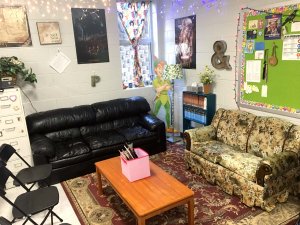
Flexible seating in a high school classroom
Courtesy of Emily Polak
For ninth-grade teacher Emily Polak, flexible seating is part of effective classroom management.

But that doesn’t mean choice is always bad. Giving students a sense of ownership in the room, paired with clear expectations for behavior, can have surprisingly positive effects. A welcoming space can reduce anxiety and boost academic performance. Emily Polak, a ninth-grade teacher in Madison, Alabama, gave her room a cozier feel by adding a couch, a loveseat, rugs, a coffee table, and posters. Her students decide where to sit—but if they can’t get their work done, they get moved back to a desk. “Discipline issues have significantly decreased. My students seem to feel more relaxed and more motivated in a setting that honors their choices,” Polak says.

5. Give behavior-specific praise: It may seem counterintuitive, but acknowledging positive behavior and ignoring low-level disruptions can be more effective than punishing or disciplining students. Instead of focusing on specific students, offer praise for the behavior you want to reinforce. For example, tell students, “Excellent work getting to your seats quickly.”

It’s also helpful to avoid using the word don’t, suggests Alyssa Nucaro, a sixth-grade English teacher in Memphis. Students are more likely to listen to instructions that include clear reasons.

6. Set clear expectations: Instead of just displaying rules for behavior, have a discussion with your students about why those rules matter. Bobby Shaddox, a seventh-grade social studies teacher in Portland, Maine, works with his students to create a list of norms—words such as inclusive, focused, and considerate—to build a sense of community. “It helps us own the behavior in the classroom,” Shaddox says. “Instead of a top-down list of rules that a teacher gives a class, these are words that we generated together. These are words that we believe in.”

George Lucas Educational Foundation

7. Actively supervise: “Presence is crucial to maintaining classroom management and to effective delivery of instruction, and it’s a skill we can develop with effort,” explains Sol Henik, a high school teacher in Pleasant Hill, California. Although it’s tempting to sit at your desk and grade papers, that’s also an invitation to your students to get distracted. Be active: Move around the room, check in on student progress, and ask questions. It’s not about policing your students, but about interacting with them.

A 2017 study found that a teacher’s nonverbal cues—such as smiling and making eye contact—can “reduce physical and/or psychological distance” with their students, boosting students’ positive feelings toward the teacher and the course material while improving behavior.

8. Be consistent in applying rules: Early in Kelly Wickham Hurst’s career as an administrator in a public high school, she was asked to discipline a black student for violating the school dress code by wearing sagging jeans. As they walked down the hallway, he pointed out other boys—all white—who were also wearing sagging pants. “Are you gonna get him, too, or is it just me?” he asked. School and classroom expectations, rules, and routines should be followed and applied fairly to all students. Don’t single out certain students—it’s the behavior you should be focused on, not the student. Correct errors when you see them and provide additional instruction or reteaching when misbehavior occurs.


Wednesday, November 15, 2023

How Tone of Voice Shapes Your Classroom Culture: Edutopia


https://www.edutopia.org/article/how-tone-of-voice-shapes-your-classroom-culture/?utm_source=Facebook&utm_medium=Social&utm_campaign=Fall+23&utm_id=Fall23&utm_term=fall+school+season&utm_content=voice+tone&fbclid=IwAR2Os9xjm1rhpszGWrOYWSA5-DMsQ7mYlLpzvt4yxP0GdcgsWgFW-DIE_QY

THE RESEARCH IS IN

How Tone of Voice Shapes Your Classroom Culture

It’s no easy task, but developing your tone of voice can build trust, reduce conflict, and set the stage for more learning in your classroom, research shows.

April 14, 2023

Using your voice to manage a classroom is one of the most powerful tools at your disposal. Teachers vocalize to impart information through direct instruction, gauge student understanding by asking questions, facilitate transitions between activities—and also manage behavior by redirecting wayward learners and issuing directives when necessary. It’s a deceptively complex, multifaceted tool, requiring constant modulation to fit changing classroom circumstances—and it can take teachers years to hone.

In a 2022 study, researchers set out to explore the nuances of tone, and especially how a teacher’s tone of voice can shape classroom culture. Researchers from the University of Essex and University of Reading analyzed how elementary students reacted to common classroom instructions—“It’s time to quiet down” or “Get in your seats, we’re starting the lesson,” for example—which were delivered in tones varying from controlling to neutral to supportive. While the words remained the same, shifts in tonality had a surprisingly large effect across multiple dimensions of classroom health, including students’ sense of belonging, autonomy, and enjoyment of the class, as well as the likelihood that they’d confide relevant personal information to educators, like their interests or academic struggles.

The researchers concluded that controlling tones “undermined” students’ sense of competence, while supportive tones “enhanced” their sense of connection with teachers. An authoritarian disposition can erect barriers: Controlling voices “dissuaded children from intentions to share secrets with their teachers,” including whether students were being bullied, were suffering hardships, or had completed work they were proud of, said the researchers, eroding the bonds of trust that are needed to learn in the social setting of a classroom.

Yet tone remains difficult to master, and harder still to sustain in a chaotic classroom environment. That’s why it’s helpful to be mindful of how things like intonation, volume, and the pacing of your speech can influence behavior, and how these qualities of voice can be judiciously deployed in ways that are likely to reinforce learning.

CANARY IN THE COAL MINE

Subtle changes in a teacher’s tone of voice can be the first signal that something is awry in the classroom. A note of panic that slips into verbal directions, a rise in vocal register or volume, or a sudden barrage of repeated instructions may indicate to students that things are starting to spin out of control and trigger a fight-or-flight response in the classroom, ratcheting up the anxiety and leading to outbursts.

Emotions are contagious, researchers explain in a 2021 study. When teachers convey warmth and express interest in a topic, students are more likely to stay engaged—and stay out of trouble. Conversely, teachers who overreact to student disruptions or are emotionally distant can unwittingly create a combative or unfriendly atmosphere. Exhibiting passion for the topic works wonders: Teachers who enjoy being in the classroom “sustained their positive attitudes when students struggled and reported spending more time teaching,” the researchers report.

Meanwhile, developing a steady, calm demeanor in a dynamic classroom setting takes time and practice, particularly when students know how to press your buttons. Take things slowly and work from a place of empathy and compassion. One way to prepare for the inevitable tests of your patience is by running scenarios in your head or with a partner. “Think through scenarios that might happen in your classroom and how you want to respond before the start of the year,” suggests high school teacher and instructional coach Emily Terwilliger. “It will make those first redirects and interventions less intimidating.”

As always, focusing on relationships first is a bedrock principle: “Bank time” with students and get to know them better, since these deposits can help ease future conflict. Finally, it’s important to let go and start fresh; it’s easy to overreact if a student keeps pushing your buttons. Try to start each day with a clean slate.

FINDING THE WARM IN YOUR ‘WARM DEMANDER’

Managing a classroom with your voice requires deftness—use a tone that’s too strict and demanding, and the research over decades is clear: Older students in particular will read it as a challenge and rebel. Go too soft on students, however, and they’ll spend a lot of time testing the boundaries of what they can get away with.

The ideal tone is a blend of both approaches, says middle school teacher Kristine Napper. “Neither high expectations nor kind hearts can do the job alone,” writes Napper, who recommends adopting a warm demander tone that focuses first “on building strong relationships with students,” and then “draws on that wellspring of trust to hold students to high standards of deep engagement with course content.”

When students misbehave in Nina Parrish’s classroom, she sees it as an opportunity to ask thoughtful questions and look for patterns. Did something spark the disruption? Are students trying to get attention from their friends, or are they bored? “Behaviors help students obtain something desirable or escape something undesirable,” she explains. Instead of demanding compliance as a first step, meet your students halfway: Set high expectations, but also spend time trying to understand what makes them tick.

There will undoubtedly be times when you’ll need to raise your voice or speak sharply to a student, but the tactic should be used sparingly. “Developing a calm, neutral, assertive voice is part of the teacher’s own self-regulation, which allows them to help students to be self-regulated and to be secure in the knowledge that the teacher will be receptive to them, but also in control,” says Linda Darling-Hammond, president and CEO of the Learning Policy Institute.

A DOSE OF THE NONVERBAL

It’s easy to forget that tone isn’t just conveyed through your voice—it can also be conveyed by facial expressions, hand gestures, and body language, which “help guide facilitation of student learning,” says Samford University professor Lisa Gurley in a 2018 study. Teachers often adopt a formal demeanor in the classroom, modeling behavior that mirrors a professional environment. Yet the difference between too-controlling and just-controlling-enough often relies not on what is said, but on the accompanying nonverbal cues that can soften perceptions.

Are you inadvertently frowning or looking exasperated when a student speaks up? Do you seem dismissive? Modern eye-tracking research suggests that teachers tend to make eye contact with students in the front row and the middle section, so consider circulating in your room and making an effort to acknowledge those sitting in the back (and on the peripheries) with your presence.

You can be formal by nature and formal in speech, and still connect. Students can detect and appreciate teaching authenticity in many forms, according to recent research. And students usually “respond positively to professors who treat them with dignity and seem approachable, even if those professors are more formal in their speech and demeanor,” says Amber Dickinson, a political science professor at Oklahoma State University, in a 2017 study. Acknowledging students with eye contact or an approving nod can “reduce the psychological distance” and help build a trusting relationship without saying a single word, she writes.

THE CASE OF THE DISEMBODIED VOICE

Vocalizing is not the only way that tone is expressed; our voice continues to have influence even in the absence of our physical presence. When giving feedback on an assignment, writing emails, or having an online discussion, the right tone can be harder to pin down—but it remains crucial—when communicating with students.

“A professor in a classroom may provide succinct instructions that students understand and appreciate, but a short email from a professor may be interpreted as cold or uncaring,” says Dickinson. In her study, she discovered that attempts to be efficient by communicating in a precise manner—such as giving clear instructions on how to upload an assignment—were often interpreted by her students as harsh. Stripped of the nonverbal cues that typically accompany a face-to-face conversation, her online persona became stern and distant, and she saw her students become less engaged as a result.

When writing messages to students, be sure to include personal touches, suggests Dickinson. It not only will make them feel more comfortable but also can create a more positive classroom culture and encourage students to reach out for help. “For example, I included content to offer general encouragement by saying things such as ‘Don’t give up, the semester is almost over, and your hard work will pay off,’ or reminding students I was happy to help them in any way,” she writes.


Successful Reading Rests on These Skills


https://atlantareads.org/2013/04/reading-skills-pyramid/reading-skills-pyramid/?fbclid=IwAR2Os9xjm1rhpszGWrOYWSA5-DMsQ7mYlLpzvt4yxP0GdcgsWgFW-DIE_QY


Formative Assessments That Inspire Creativity: Edutopia

 From:  https://www.edutopia.org/article/creative-formative-assessments?utm_source=Facebook&utm_medium=Social&utm_campaign=Fall+23&utm_id=Fall23&utm_term=fall+school+season&utm_content=formative+assessments&fbclid=IwAR0KkqhpghFbGM2MwohiXoJJBzDqgEbE3zufdxbhk_dJzL3J-PCx31NkVao

FORMATIVE ASSESSMENT

13 Formative Assessments That Inspire Creativity

Sometimes mixing in formative assessments that go a step beyond exit slips and low-stakes quizzes can inject some fun—and creativity—into learning.

March 3, 2023

It’s always better to know if a student is struggling before a big test is in the rearview mirror. But students often lack the self-awareness to monitor their own learning, and may struggle to work up the courage to ask for help. Others may overestimate their mastery of important ideas and concepts, tricking their brains into thinking they’re prepared for a test when they’re not. 

So when it comes to student learning, how can you tell what's sticking—and where additional instruction or review could make a difference?

Formative assessments are typically short, gradeless ways to evaluate what students know while they’re still in the process of learning it. When used early and often, they can shine a light on individual student progress, serve as general indicators of how the class is doing as a whole, and inform subsequent instruction. This process of actively checking in with students on their journey toward mastery is “especially effective when students are given tactical feedback, immediately followed by time to practice the skill,” says Todd Finley, a tenured professor of English education at East Carolina University.

Quick checks for understanding aren’t new, of course, but when time allows, occasionally injecting an element of creativity into formative assessments can deliver unexpected benefits. For example—regardless of a student's artistic talent—research suggests that drawing the information they’re learning can increase student recall by nearly double. And when kids are encouraged to tap into their imagination to show what they know, they tend to ask more innovative questions of themselves, brainstorm fresh solutions to problems, and synthesize material in original and surprising ways. 

Here are 13 formative assessment strategies that lean into creativity—inspired by the work of several Edutopia contributors, and from Finley’s handy list of quick checks for understanding. 

Simple Symbols: Sketchnoting—simple, hand-drawn renderings of things like facts, dates, or abstract concepts—can be a great way to help students process vocabulary. Educator Wendi Pillars has her students co-create a symbolic language library, working together to visually represent important terms from a unit. After choosing 10 terms, students develop an icon or character to correspond with each one. For example, a drawing of a sun can represent energy or a tree can represent life.

Write a Letter: On a sheet of paper or an index card, ask students to explain a new concept they've learned in the form of a short letter to a friend or family member, pretending the other person is new to the information. This process of explanation can open students' eyes to what they know and what they don't, explains Woo-Kyoung Ahn, a psychology professor at Yale University who uses a similar strategy with college students before exams.

Tweet Like a Historian: Challenge students to enter the minds of popular historical figures, tweeting about major events in the figure’s life as that person would have, suggests former educator Matthew Lynch. To get a firm grasp on how well students understand their chosen figure, ask who their figure might be following on social media, as well as topics that would be “trending” on their feed at the time. Educator Jill Fletcher prefers to use a paper template so that students can engage in the exercise without going online.

Playful Pamphlets: An effective brochure is easy and engaging to read, and offers eye-catching design. Ask students to create their own brochures that describe the key features of a concept, or to explain a historical event or scientific discovery. This can be done using paper and art materials, or digitally using applications like Canva or Google Slides.

Do It Yourself TED Talks: Most students are familiar with TED Talks, this strategy provides them with the opportunity to give their own. Educator Katy Farber describes them as "one person’s short presentation of an idea worth spreading." After showing an example that students can model, ask them to find an idea worthy of spreading from the day's lesson and create their own speeches to present the information. Those who feel comfortable can share with the class.

Comic Creators: Using digital creation tools like Canva, kids can create their own comic strips to connect new material and information from past units. The comics shouldn’t be a "regurgitation of knowledge," explains Andrew Miller, director of teaching and learning at the Singapore American School. Instead, they should have an authentic purpose, making it a fulfilling exercise where students create products that are informative and useful to peers. After a lesson on nutrition, for example, students could make comics that explain the major nutrients—as well as the role they play in how bodies function—that could be displayed in hallways for classmates to learn from.

Build-a-Billboard: Have small groups work together to create an advertisement, with visuals and text, to highlight a newly learned concept like Manifest Destiny or the scientific method. Students in San Francisco Unified School District health classrooms learn about tools advertisers use to convince people to buy their products, then create their own billboards. "If you were going to make an ad for your favorite fruit or vegetable, what techniques would you use?” asks health ed content specialist Christopher Pepper.

Sing It Out: Asking students to sing or rap about a lesson can be a fun change of pace—and rack up a few giggles. First, students identify the main concept of a lesson and list related keywords. In a rap about the order of operations, for example, educator Alex Kajitani lists “operations, order, parenthesis, exponent, multiply, divide, add, and subtract.” Using the website RhymeZone.com helps identify what words rhyme with each key term, then students can begin writing their rap, song, or even spoken word poem.

Illustrate Connections: “A student who draws as they learn considers the following: How should I represent the relationship between these parts? How large/small should I draw these parts? What shape should they be? Where do I place each part?,” explains instructional leader Shveta Miller. Invite students to draw a picture that illustrates a relationship between terms from the lesson or recreates a scene from their reading. Providing reflection questions like "How well did I recall the material after having represented it in my drawings?" or “When would drawing as I learn be useful? When is it not useful?” can be a useful add-on to the exercise. 

60 Minutes: Students pair up and pretend they're a guest expert on the television program 60 Minutes or their local news broadcast. During their segment, they'll need to answer a few of their partner's interview-style questions—"What is the purpose of feudalism in a society?," for example. 

Laughable Lists: At the end of a lesson or once students have finished assigned reading, ask them to enumerate what they think are the top ten most important takeaways. The twist? Students will have to try to infuse humor into their list of observations. Sharing a few examples before they begin can help students who might struggle with the exercise at first.

Cut and Paste: Encourage students—on their own, in pairs, or in groups—to make either digital or paper collages to demonstrate their understanding of the lesson's major themes and concepts: anything from matter and energy, to fractions and decimals. If time allows, have a few kids present their collages to the rest of the class and explain their thinking.

3-2-1 Action!: Choose a selection of excerpts from a recently read text—like a poem, play, or a short story—for students to dramatically interpret and perform. Without the use of props, costuming, or sets, students must not only have read the text but understood it enough to convey an insightful character analysis, as well as the mood and tone of the scene. These 5-minute performances can be recorded and submitted to the teacher to review, or shared in class for peers to see.