Sunday, July 21, 2024

Reggio Emilia Inspired Practice shared these: Froebel and Montessori

 From: Facebook page: Reggio Emilia Inspired Practice

 https://www.facebook.com/groups/1461127847454766

 Their Facebook page says: 

This group is intended to share best practice and to learn about the Reggio Emilia Approach. This is an innovative and inspiring approach to early childhood education that values the child as a strong, capable and resilient human being, rich with wonder and knowledge.
For more information about Reggio Emilia Inspired Practice, visit this website


Saturday, July 13, 2024

Helping Students Manage Conflict: Edutopia

 From:

https://www.edutopia.org/article/helping-students-manage-conflict?utm_source=Facebook&utm_medium=Social&utm_campaign=BTS+24&utm_id=BTS24&utm_term=conflict+resolution&utm_content=practitioner&fbclid=IwZXh0bgNhZW0CMTEAAR1ycvU-h_XvOEc24yASviFFm6YxA0demKEsA1oPwilrMseynZMAzpXJRI4_aem_xq3q4Gy00OPjYVVL7eHzIw


SOCIAL & EMOTIONAL LEARNING (SEL)

Helping Students Manage Conflict

Answering questions designed to regulate emotions may make it easier for students to find solutions to common disagreements.

June 25, 2024
Teenage students working together and talking
FatCamera / iStock

These days, our world is inundated with heated discussions, polarizing debates, tense protests, and culture wars, whether they be about abortion rights, gun control, affirmative action, climate change, the Russia-Ukraine war, or the Israeli-Palestinian conflict. Discord is part and parcel of life. At a time when the nation is so divided, schools must do more to help students manage conflict. How can schools empower students to resolve conflicts with peers or adults?

Problem-solving is an emotion-regulation strategy of taking action to directly address an emotional situation. Think about 14-year-old Padma talking to a peer who called her names about how sad she felt. Or 17-year-old Alejandro encouraging his classmates to put more effort into their group project after being pressured to do the heavy lifting. Problem-solving empowers students to take charge of their emotional needs. It can increase students’ self-efficacy in problem resolution and prevent similar situations from happening again.

A powerful problem-solving tool for conflict resolution is students’ expressing their emotional needs to peers or adults in a clear and civil manner. Consider 16-year-old Chris, who feels angry and advocates his need for an apology from a peer who shoved him in the hallway. Or 13-year-old Max, who feels excluded and shares their need for meaningful social interactions. There are five evidence-based steps to problem-solving.

5 PROBLEM-SOLVING QUESTIONS FOR CONFLICT RESOLUTION

  1. What is the problem? Students state how they feel and perceive the situation. ”I” statements are a helpful communication tool for students to state behavior that bothers them without sounding unkind. For example, Chris can say, “I feel annoyed when you shove me without apologizing because it hurts.” Or Padma may say, “I feel sad when you call me fat because it puts me down.” Unlike “you” statements, “I” statements enable students to express their emotions and concerns without others shutting down.
  2. What are the solutions? Students identify what they need from the situation. They come up with different action steps that others can take to remedy the situation. For instance, Padma may expect an apology or want the name-calling to stop. Max may expect an invite to a social activity or want to tag along.
  3. What are the consequences? Students assess the helpfulness of each action step. What is good about this action step? What might be bad about this action step? Students choose an action step that is specific, reasonable, and doable for others. For example, Chris may want his peer to never push him, but accidents may occur in a crowded hallway. Alejandro may prefer his classmates to finish the remaining work themselves, but they may not know what to do, resulting in a bad grade for the group project.
  4. What is the best solution? Students state what they need out of the situation. ”I” statements are an effective communication tool in this case for students to state how others can meet their needs without sounding coercive. For instance, Max can say, “Can I go with you to the movies?” Or Alejandro may say, “I need us to work together on this project. Would you help write up the results?”
  5. What is the result? Students determine the helpfulness of their solution. If it is helpful, the problem is resolved. If it is not helpful, students could retry by returning to step one and perhaps enlist an adult they trust at school to problem-solve with them.

However, problem-solving requires time and effort to generate, select, and enact solutions. Problem-solving can also lead to frustration when the solution, or some part of it, is not within students’ control. Imagine that 18-year-old Cody, who feels trapped and is being made the subject of rumors, asks others to stop spreading or fueling them, but he has little control over their behavior. So, if students are fatigued or solutions are beyond their control, they should try other emotion regulation strategies (e.g., cognitive reframing, distraction, emotional support seeking) in tandem.

Conflict resolution through these problem-solving strategies is one way to help students manage minor disagreements with classmates. More serious disputes may require some degree of adult intervention. The bottom line is that all students should feel safe and accepted at school, no matter their race, gender, language, religion, or ability, especially amid the current contentious social-political landscape, and educators have to take steps to create this inclusive, welcoming environment.


Simon Says!

 Such fun!  From: https://ecdc.nd.edu/?fbclid=IwZXh0bgNhZW0CMTAAAR0vrV6Ic0Bk-Ui45wTjbrHuIN44L_PlELx56N-U0YIQGTFvcSyJmXp6nOw_aem_F6O3qlO7J-UoArYVQnU9nA


Monday, June 17, 2024

FROM CEC: EXCEPTIONAL TEACHER RESOURCE REPOSITORY


School's out, and it's time to rest, recharge, and plan for the next school year. CEC's Exceptional Teacher Resource Repository contains a wealth of expert-reviewed resources created by educators like you! With resources on topics like DBI, adaptive technology, progress monitoring, and more, CEC members can set themselves up for success for the school year ahead.

https://exceptionalchildren.org/teacher-resources


End of the Year Reflection: Picture Books that Model Writing an SEL

 From: https://www.edutopia.org/article/picture-books-boost-literacy-sel?utm_source=Facebook&utm_medium=Social&utm_campaign=Spring+24&utm_id=Spring24&utm_term=SEL+books&utm_content=practitioner&fbclid=IwZXh0bgNhZW0CMTEAAR1TDRygu9O1sYcayr4fO7G0hUihtURJ-PGOFQf9A2mDx_7jJUyHFizpJek_aem_ZmFrZWR1bW15MTZieXRlcw

LITERACY

Picture Books That Model Writing and SEL

Teachers can engage students in end-of-year reflection using these mentor texts to model SEL competencies and writing skills.

June 12, 2024
Elementary school teacher reading book to students
monkeybusinessimages / iStock

The final weeks of school are exciting but overwhelming. Before becoming a literacy consultant, I was a fourth-grade teacher; one of my goals was to ensure that students had time to reflect on their accomplishments and set goals for their academic as well as social and emotional learning (SEL) the following year. 

I leveraged our final writing assignment and chose mentor texts to model the best examples of craft, structure, and conventions for my growing writers and illustrators. 

Marrying writing and reflection can be efficient and effective at the end of the year. Below, I share my favorite mentor texts that create opportunities for SEL.

PICTURE BOOKS THAT BOOST LITERACY AND SEL

Maurice: Maurice—a Parisian, accordion-playing dog—has music to share with the world. When times change and Maurice loses his audience, he’s heartbroken and uncertain how to survive. With help from feathered friends and memories he carries in his heart, Maurice learns how to share his gift with the world once more. As students follow his journey, there are many opportunities for them to think about responsible decision-making, self-awareness, and relationship skills. 

Jessixa Bagley’s book demonstrates foreshadowing; the use of precise nouns, verbs, and adjectives; different kinds of sentences (simple, compound, complex); similes and metaphors; introductory prepositional phrases; speech bubbles and dialogue to deepen character development; white space and line breaks that echo musical measures and create surprise for the reader; and rhyming action.

Students can craft their own verse set to a familiar song or original composition; their lyrics can describe themes of loss and rebuilding. You can also copy the cover of the book (under the jacket), which is a replica of Maurice’s accordion, and ask students to add words to each of the keys to describe things that keep them grounded when they’re having a hard time or feel alone. (Grades Pre-K–2)

The Perfect Place: Matt de la Peña’s newest picture book depicts the story of Luca, a boy who goes to a fancy private school in an upscale neighborhood, where he gets excellent grades and fits in perfectly. However, his home life, at least in Luca’s mind, is full of “not so perfect” circumstances; his mother works long hours at her waitressing job, he shares his small bedroom with his baby sister, and his father’s truck is continually breaking down.

Then, Luca visits “The Perfect Place” and wonders what being perfect really means. This text supports self-awareness, social awareness, and responsible decision-making. It showcases juxtaposition, temporal phrases, different sentence lengths (simple, compound, complex), precise verbs, a doubling up of adjectives, and sensory details.

Having students craft poems about the illusion of perfection helps them prepare for challenges that may lie ahead. Having students analyze abstract art (like the orange juice stain in the text) and discuss what they see encourages them to find unusual beauty throughout life. (Grades Pre-K–2)

Wait: In Antoinette Portis’s book, a mother and child attempt to make it to the train to get back home. The child has one perspective of slowing down, taking in every sight and sound to enjoy the stroll. The mother hurries, rushing the child to make the train. With only two words spoken (“Hurry” and “Wait”), this short but powerful masterpiece shows readers the beauty of slowing down and observing the world around us.

This text connects to three SEL competencies: self-awareness, social awareness, and relationship skills. It demonstrates techniques like showing movement of time through setting; close-ups versus landscapes; simple, evocative facial expressions; patterns and color; and perspective.

Invite students to contemplate how they might slow down over the summer and observe the world more closely. Ask them these questions: What can you do to enjoy every second of summer? What mind/body exercises can you practice to help you “wait” for things, even when you’re in a hurry? Students can develop mantras to center themselves when impatient or stressed. Discussions, interactive activities, or shared writing capture learners’ responses. (Grades K–1)

Not Perfect: In Not Perfect, by Maya Myers, illustrated by Hyewon Yum, two friends, Dot and Sam, create a poster as an at-home assignment. Dot is surrounded by lots of talented and supposedly “perfect” people in her life and feels like she can’t do things that others seem to do with ease. With help from her friend, however, she recognizes what perfection really means.

This book explores relationship skills, responsible decision-making, self-management, and self-awareness. It exemplifies repetition; internal thinking; twin sentences; purposeful fragments; simple, compound, and complex sentences; limited but meaningful dialogue; environmental print; and intentional uses of white space, line breaks, and font size to exemplify emotions. 

Ask students these questions: What are talents you have that you could teach someone else this summer? What might you try for the first time this summer? How will you encourage yourself if, at first, you fail? What advice can you give yourself and others about the importance of not giving up, even when things are tough? 

First graders might answer in simple writing assignments or posters. Older students can craft paragraphs or use Google Forms to share with caregivers. (Grades 1–3)

Little Tree: While all other trees in the forest adapt to the seasons, in Loren Long’s book, Little Tree doesn’t; he fears change and is apprehensive about parting with his leaves. This simple, beautiful story gives students opportunities to discuss when it’s OK to let go and change, even when it’s difficult. It exemplifies sensory details, the repetition of one anchoring line, purposeful ellipses, various sentences (interrogative, exclamatory, declarative, imperative, fragments), temporal language that shows movement through time, personification, and a circular ending. 

Use this text to consider self-awareness, responsible decision-making, and self-management. To help students build confidence when facing fear or doubt, ask them these questions: If something concerns you about the summer, what is it, and how can you help yourself quell those fears? While the next school year may bring new challenges, what can you do over the summer (academically, socially, emotionally, physically) to make sure that when fall arrives, you have the best year possible? Who is one person you can rely on for support when you’re scared? What makes them a wonderful friend? 

Students can create mini-portfolios (handwritten or digital) to communicate their summer plans with family. (Grades 2–5)

Picture books model craft, convention, and structural moves—and provide opportunities to discuss students’ SEL. Leveraging their power makes those final days more rewarding.

SHARE THIS STORY

  • email icon


Thursday, May 23, 2024

Seven Essential Motor Skills for Higher Learning


7 Essential Motor Skills needed for a Child to Reach Academic Success | ilslearningcorner.com

7 Essential Motor Skills needed for a Child to Reach Academic Success

This article provides information about the 7 essential motor skills needed to “awaken” the brain for better academic success. Integrated Learning Strategies (ILS) is a learning and academic center. As a reminder, ILS is not a health care provider. None of our materials or services provide a diagnosis or treatment of a specific condition or learning challenge you may see in your child or student. If you seek a diagnosis or treatment for your child or student, please contact a trained professional who can provide an evaluation of the child.

We have always been a big proponent of purposeful movement to help kids learn and thrive in the classroom. But, more importantly, we have seen the impact purposeful movement has on the brain.

Did you know building your child’s motor skills is not only for staying healthy and strong, but also for supporting every area and aspect of your child’s learning development?

Don’t believe me?

Think of the body as a tool needed for the mind to grow so it can reach the highest level of academic performance. Just like when we lift weights or run a marathon, the more we build our endurance, our bodies get stronger and faster.

As we “exercise” and “warm-up” the body, we are also giving the brain an even better workout.

Why is PURPOSEFUL Movement so Important?

 
From: https://ilslearningcorner.com/7-essential-motor-skills-needed-for-a-child-to-reach-academic-success/?fbclid=IwZXh0bgNhZW0CMTAAAR1MN3fjCrY3ptjTDc1f2dQKBdrJqrDwizj3C3JRiNcAbid3uLNE7Ig7PFA_aem_AULKZQ53TU9wtNP7-cDpplrHupOiMNFb217UYAcIc1bfeBA5qLOOM0l09AAfAdGYxMeEMBVRqAgTk6KTbeaM3gNX

Why does the body need strong motor skills for my child to learn?

Most people don’t realize there is a body and mind connection. When the body is prepared for learning, learning becomes automatic.

We want our kids to naturally read words across the page, have the ability to write words on the page and copy notes on the chalkboard. Surprisingly, many kids today are entering school without these simple basic skills.

The end result, gaps in learning start to form and a child may begin to breakdown as those gaps get wider and wider.

However, purposeful movement exercises can help. They can be the key to strengthening a child’s body for academic success.

Here’s a breakdown of all the motor skills kids need and use on a daily basis for higher learning. Did you even realize they use their bodies so much?

7 Motor Skills needed for better Academic Performance

#1 – Hand-eye Coordination

A strong development of hand-eye coordination can prepare the brain and body for handwriting, letter formation and tracking words across the page

#2 – Bilateral Coordination

Developing bilateral coordination is an important skill needed for simple tasks like holding the paper with one hand while the other writes across the page.

#3 – Core Muscle

Believe it or not, a strong core can help a child sit upright in their chair while supporting the head for copying notes off the chalkboard.

#4 – Balance and Coordination

If a child’s balance is off, you may begin to see them fidget in their chair. Building better balance and coordination can support your child’s attention and focus, emotional regulation and behavior.

#5 – Crossing the Midline

Crossing the midline activities are important for brain development. They can help a child track words across the page, problem solve and write words from sentence to sentence, paragraph to paragraph.

#6 – Back to Front Activities

Because higher learning takes place in the higher centers of the brain, kids can do back to front activities to help organize thoughts, improve speech and language, support memory and help follow directions.

#7 – Patterning

Playing games and participating in activities that require different patterns help kids with sequencing, fact retention, math and equations.

Warm-Up Activities for “Awakening” the Brain

If you don’t know where to begin or if you have students that need additional support at home, this FREE warm-up packet can help.

It’s a great way to get your children and students better prepared for homework, studying, tests and other academic performances.


Better Ways to Ask---and Answer---Questions in Math Class: Edutopia

 From: https://www.edutopia.org/article/asking-questions-math-class?utm_source=Facebook&utm_medium=Social&utm_campaign=Spring+24&utm_id=Spring24&utm_term=math+questions&utm_content=practitioner&fbclid=IwZXh0bgNhZW0CMTEAAR1KBdmxuXP8vwPZ3sRHuPa0sg4oV10etTM1S_uzj7qJGxMGHUf6bQPjTDs_aem_AUKB37Vz_cBG6dGB8rdC1iGI2j6UHQecqPVD3viHqOTEqsueAK1bBrfB6VX3lJ3UWmlFkTtXBjbgQb8njar7gSAM


STUDENT ENGAGEMENT

Better Ways to Ask—and Answer—Questions in Math Class

Elementary students benefit from questions that create conversations about math concepts and give all children a chance to answer.

May 17, 2024
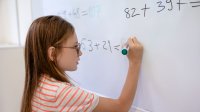
Photo of elementary student doing math problem on whiteboard
Zinkevych / iStock

I recently observed a fifth-grade class that would have felt completely familiar to most teachers. A problem was put on the board, and students worked for a few minutes to solve it. Then the teacher asked for a volunteer to explain the solution. Lots of hands went up. 

The question, at first, looked easy: It was 5 + 5 x 5 - 5. When Abby, one of the students who had been identified as struggling in math, raised her hand, I had a sinking feeling in my stomach. When the teacher called on her, she confidently answered 45. The teacher wrote down Abby’s thinking: 5 + 5 = 10, 10 x 5 = 50, 50 - 5 = 45.

But what looks just like an easy string of computation is really a test about whether students remember order of operations. The teacher turned to the class and asked if everyone agreed. There was an immediate chorus of “nos.” He then called on one of the other students, who gave a long explanation about PEMDAS, and concluded (correctly) that the right answer would be 25. Abby visibly shrank in her seat. Even if the teacher responds kindly, as happened in the class I observed, this moment would be deflating. 

HOW QUESTIONS ARE TYPICALLY ASKED IN ELEMENTARY MATH

The problem in Abby’s classroom is not that she got the wrong answer. Instead, the problem is that almost all of the questions a teacher asks in a math class are answered correctly, because we purposefully select for right answers by how we call on students. We only call on those students who raise their hands.

This is a problem because we do not hear all of the voices in the room. In most classrooms, less than a third of students answer almost all of the questions. Students who do not participate are not engaged, and students who are not engaged do not learn.  

This way of choosing students also leaves everyone with the impression that most students “get it.” It gives the teacher a false sense of confidence about what the students know and makes it less likely that misunderstandings will be addressed. A struggling student often assumes they are the only one who doesn’t know the correct answer, and this belief reinforces their feelings of inadequacy. 

Finally, it creates a classroom culture that does not encourage risk-taking or productive struggle. Even if we talk about growth mindsets and celebrate student thinking, the rarity of wrong answers makes mistakes stand out as abnormal rather than part of the process of learning.

Having students formulate a question based on a situation or a picture changes the role of the student from a passive answer machine to a mathematical thinker. The goal of our questions should be to create a conversation around the mathematical content.

STEVEN GOLDMAN

MOVING TOWARD MORE MISTAKE-FRIENDLY PARTICIPATION 

The picture of students eagerly raising their hands to answer a question is so ingrained in our mental images of what a good classroom looks like. But eliminating this practice is one of the most important changes we could make. What would replace it?

Asking different, and better, questions: Before we can replace hand raising, we first need to improve the questions themselves. Too many of our questions are procedural and require a simple answer, delivered almost immediately. This kind of question in itself encourages students to think that their role is to answer quickly and accurately, rather than to engage in a thoughtful process that builds understanding. 

For example, if we really wanted to explore the idea of order of operations, we could have started with what students can tell you about the problem. They might notice that it has all fives and that it involves three different operations. The most interesting thing about the expression is whether there is only one order you can solve it in. Students who are overly procedural will insist that you have to multiply first and then work left to right, but there are multiple ways to begin.

A good question should focus on ideas and on what a student is thinking rather than on something that is categorically right or wrong. Questions about what patterns you notice, or how two approaches are similar or different, open up the discussion in a way that everyone can participate in. You can also focus on the process, eliciting where you might start on a problem or how to identify important skills that a problem presents.

Or you might analyze a possible solution together and talk about what you see. Analyzing a solution that doesn’t work is even more engaging. Having students formulate a question based on a situation or a picture changes the role of the student from a passive answer machine to a mathematical thinker. The goal of our questions should be to create a conversation around the mathematical content.

New ways of getting students to answer: With better questions we can be more comfortable taking the next step, which is finding a neutral mechanism to call on students. Some teachers use equity sticks or even phone apps that help randomize who is called on. There are teachers who bypass the calling on students and use whiteboards or Post-it Notes for responses. I prefer old playing cards onto which I have written the student’s name with a big black marker. Cards are easy to hold and to shuffle. To use this form of cold calling requires some up-front work with the students to establish a nonthreatening environment where they can feel comfortable admitting they don’t know.

Often the best alternative to hand raising is simply to curate the discussion. If students are working by themselves or in small groups, it gives the teacher a chance to observe and select which student responses to talk about. In a curated conversation, the teacher chooses who will share based on which responses will create the most engaging debrief. Curated conversations often begin with sentences like “I notice that Abby and her partner were…” Curating allows a wider range of choices about who participates and allows the teacher to build toward a more productive conversation by managing the student work that serves as the focus. 

To help a student like Abby, it is not enough just to make her feel OK about her mistake. We have to have more opportunities where she sees that other kids make mistakes too and that she has something real to contribute. We have to make sure that she feels like she belongs in this classroom and that her participation is valued. We can’t do that if we have created an environment where it feels like we only care about the students who have raised their hands and provided us with a right answer.