8 Classroom AI Policies Developed by Teachers
Setting clear, shared expectations around student AI use is uncharted territory for many teachers. Educators across disciplines and grade levels share their current policies.
Save this article to get better recommendations in your Homeroom feed.
At Brimmer and May, a pre-K to 12 private school in Massachusetts, it’s “mostly up to the individual teachers” to decide how and when AI should be used by students, says high school history teacher David Cutler.
That’s a level of responsibility and autonomy he welcomes.
“We all teach different disciplines at different levels and we're the experts in the room,” Cutler surmises, reflecting on his school’s decision to give teachers discretion. “We're the ones best informed to make decisions, including those about AI and edtech."
But not every teacher feels well equipped to make that call. Confronted with a revolutionary new technology that's rapidly evolving, educators have little precedent to draw on: “We don't have a social contract,” for AI, explains Marc Watkins, a lecturer at the University of Mississippi and founder of the Mississippi AI Institute for Teachers. “We don't have an agreed-upon set of principles that we can all look at.” School and district leaders, too, often struggle to provide clarity, says veteran educator Leah Cleary: “This might be the messiest policy landscape I’ve ever tried to make sense of. We’ve got federal whiplash, state guidance that may or may not matter, districts scrambling to figure out if they even need a policy, and teachers like you and me, just trying to get through the day without completely redesigning our entire curriculum.”
What is clear, however, is that student use of AI is outpacing policy. Over half of teens surveyed reported using chatbots to “search for information or get help with schoolwork,” according to a recent Pew Research Center report, but attitudes toward the technology are far from unanimous, says Victor Lee, faculty lead for AI and education at the Stanford Accelerator for Learning. Some students see AI “as a bad force in the world,” he explains, while others are caught between the obvious utility of AI tools and the fear of leaning too heavily on a technology that is quietly eroding their cognitive development.
Some educators are exploring new ways to meet the challenge. “I knew I needed to be clear with students so they aren't guessing what's allowed or not, but even more so because they don't know what responsible AI use looks like,” explains classroom educator Stacy Kratochvil. While it’s tempting to discuss policy once and move on, her goal is to sow the seeds for future conversations. “I recommend revisiting AI expectations before major assignments so students learn to make thoughtful decisions.”
We asked teachers across disciplines and grade levels to share the specific strategies they’ve developed to establish shared values, expectations, and policies about AI use in their classrooms.
STRUCTURED PERMISSION AND TRANSPARENCY
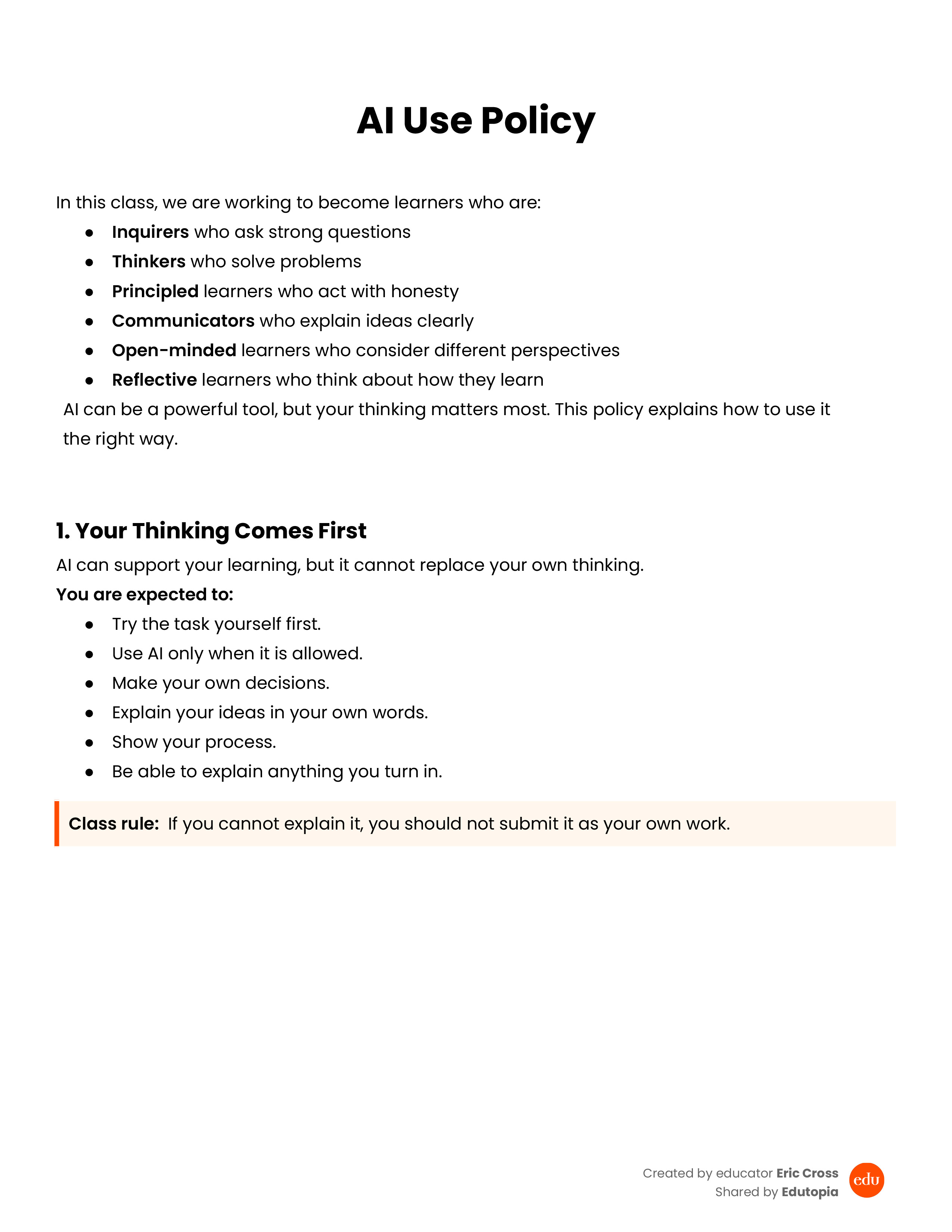
When AI tools first emerged, middle school science teacher Eric Cross chose not to ban them. He’d learn much more, he decided, from allowing students to use these tools openly and observing them. “It’s hard to learn about behavior when we push it into hiding,” he says.
Disclosures Required: Transparency became the foundation of Cross’s policy: each assignment is clearly marked with the level of AI use (if any) he considers acceptable, and students must submit a standardized “AI Use Note” detailing their process. The template provides sentence starters that require students to document what AI tool they chose, the prompt they entered, and how this impacted their process. A student might submit the following, appended to a biology task:
I used Gemini to help me understand the word “homeostasis.” My prompt was, “Explain homeostasis for a 7th grade science student.” It helped me understand the idea. After that, I wrote my own sentence in my own words and added my own example about body temperature.
Ask Permission First: Borrowing from higher education, high school English teacher Brett Vogelsinger’s course syllabus takes a similar tack: “Like most major colleges, I require that you ask permission before inviting AI into your writing process so that we can together assess how it can be most helpful without taking away opportunities to learn the required skills for the course,” he writes. On major writing projects, students fill out a transparency survey, disclosing any AI or human assistance and inviting reflection.
The Rules Apply to Everyone: When working with college students, Watkins begins by modeling transparency himself. His classroom policy delineates various tasks he will not use AI for—like providing feedback, grading work, and writing letters of recommendation—along with his reasoning: “These purposes… can impact the relationship I have with you, and that is something I value much more than efficiency,” he writes.
Watkins also commits to disclosing his own AI use and requires students to do the same, inviting them to “craft their own statements” about how or whether they’ll use AI in his class. For clarity, Watkins labels each assignment with clear terms of engagement, like whether students can ask for help (and from whom), whether they can collaborate with others, and what level of AI use, if any, is permitted.
CO-CREATING SHARED VALUES
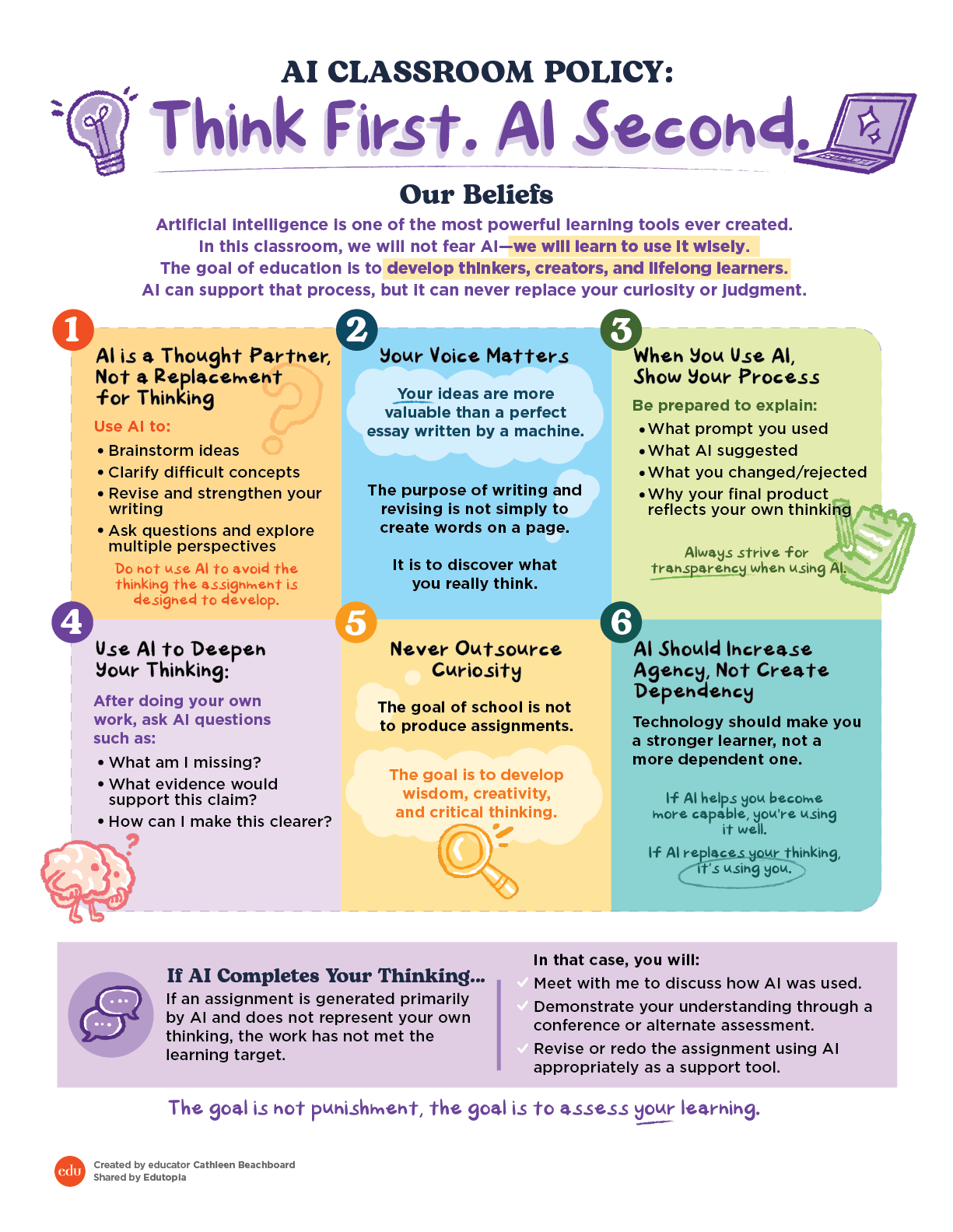
High school English teacher Cathleen Beachboard recalls that her first attempts at a classroom policy were little more than a list of AI dos and don’ts. “I now view the role of the policy as defining how learning should occur,” she says.
Preserving Student Voice: Informed by research that suggests “humans naturally value things that have their fingerprints on them,” Beachboard opened the floor for conversation, posing questions like If AI is going to continue to be present in our lives, what type of classroom do we want? Students’ responses helped “develop values” instead of rules, which became the backbone of a formal policy that hangs on her classroom wall.
Each year, as the technology and her students’ understanding of it evolve, Beachboard revisits the policy with her new classes, discussing what remains relevant and what can be added or challenged. “This collaborative process is extremely important because policies should not simply be handed down; they should be discussed, questioned, and improved upon via collaboration.”
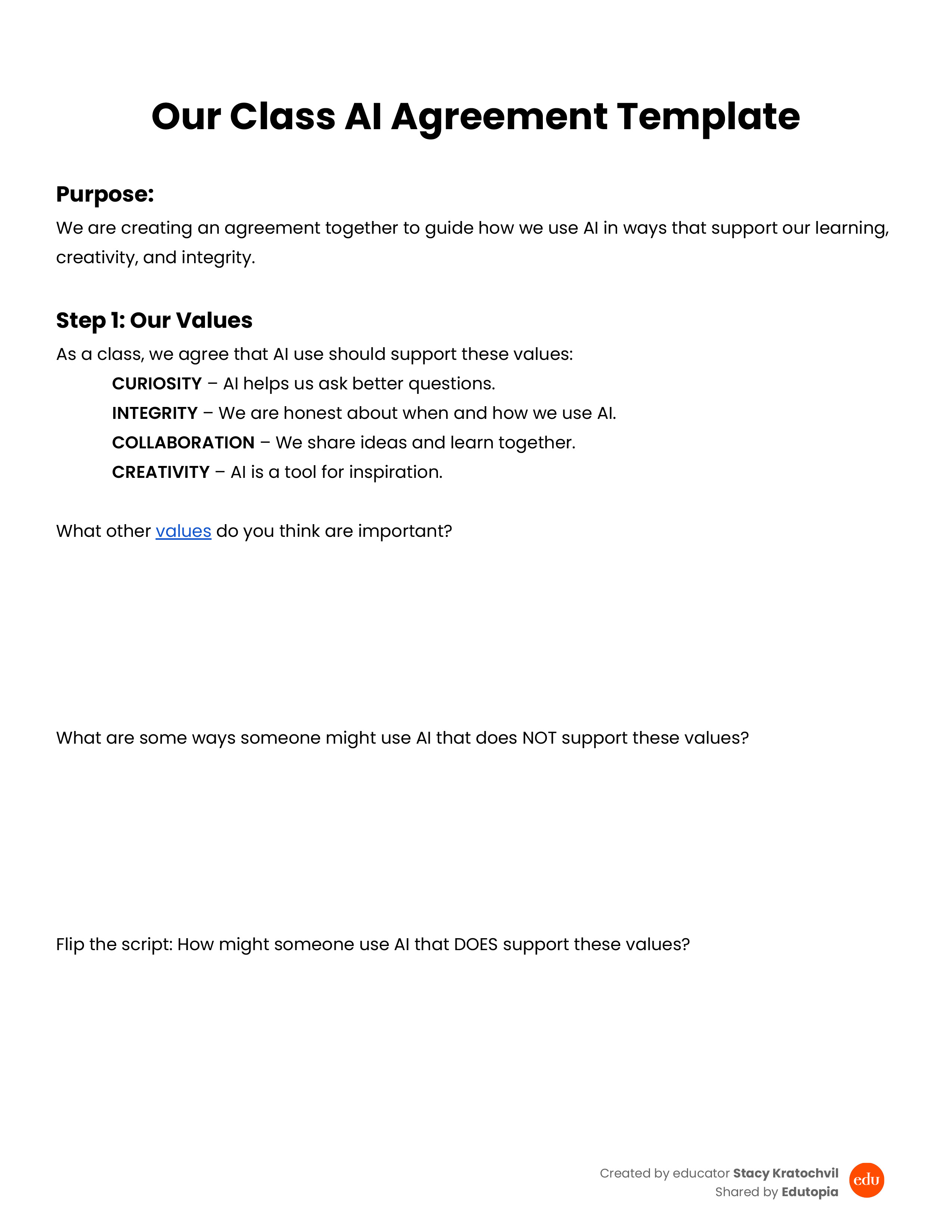
Co-Creating New Norms: Stacy Kratochvil takes a similar approach, prompting open class conversations first to introduce what AI is and help students consider its role in their lives. Next, students co-create an AI class agreement together. She starts by naming core values that the class agrees their potential AI use should support. For example: “Integrity—We’re honest about when and how we use AI.” On a worksheet, students suggest additional values, naming ways that AI might support or undermine them, then brainstorm AI use cases that should be allowed or prohibited, or that might require teacher insight. The final document is displayed prominently in her classroom and revisited throughout the year.
A Common Code of Ethics: College lecturer Sydney Sharkey, too, was craving more nuance in classroom AI conversation that often treats students as “cheaters-in-waiting.” So she “ditched the lecture about ‘AI misuse’” and opened a dialogue.
With the assistance of guiding questions like What types of AI use feel ethical, helpful, or appropriate in a writing course?, Sharkey asked students to document their thoughts on a shared Padlet board and reply to at least two of their classmates. “Several students admitted they’d experimented with AI before but hadn’t felt comfortable asking what ‘counted’ as cheating,” Sharkey explains. “Others expressed relief that we were even having this conversation.” She then condensed and synthesized the discussion into a co-created classroom policy, including approved and inappropriate uses of AI, and an expectation that students would transparently disclose their usage.
DISCOURAGING OR HEAVILY RESTRICTING AI USE
Some educators believe the use of AI at any stage of learning may be damaging.
In his history classroom, Cutler sees his role as helping students to become competent, critical thinkers and writers. “Anything that is able to impede that I want to limit to the best of my ability,” he explains. For this reason, he keeps generative AI use to a minimum. “I really prefer that they don't use it,” and if they do, ”I want it to be under my supervision.”
In Your Own Style: Cutler’s school’s broader Artificial Intelligence and Academic Work Policy clearly states that “while an AI tool is helpful in generating ideas,” students “who take the ideas or works of others” to pass off as their own are “considered to be plagiarizing” and will earn a zero. This includes using AI software like Quillbot or Grammarly Premium to enhance the language, tone, or sophistication of their writing; asking AI chatbots to write full sentences or paragraphs of text; or sending AI off to conduct research on their behalf uncited.
With this high-level foundation set, his classroom policy doesn’t mince words:
Students are strictly prohibited from using Al to assist in any production of work, unless otherwise noted by Mr. Cutler. Use of Al will result in an automatic "zero," without the ability to revise or redo for any credit.
A Defense of Humanism: In contrast, students “have noted that they’ve never seen an AI policy this detailed,” high school humanities teacher Alexa Garvoille says of her syllabus. Across several paragraphs, Garvoille elaborates on why she would prefer students “not use ChatGPT, Gemini, Claude, AI-based editors, or other LLMs to generate ideas, summarize readings, or brainstorm for this class.”
Acknowledging that it’s simply too challenging to enforce an all-out ban, like Cross and Vogelsinger, she requires students to transparently describe how they’ve used AI on each assignment. The length of her policy, she admits, “didn’t stop a few students from using AI,” but interventions were “conversation-based and focused on redoing work.”
Sign on the Dotted Line: To affirm they’ve understood his policy and keep them accountable, Cutler asks each student to sign it. “There were a few instances of clear AI use,” he says. A couple of students claimed they weren’t aware of the AI policy, which Cutler quickly dismissed: “I've said it a million times in class each day for the last six weeks. You signed your name to a statement that you understand this. And ‘no AI’ is also all over the assignments.” Despite his policy, he allowed those students to redo the work for up to half credit, an offer some (not all) took him up on: “I try to be understanding when mistakes are made where there's no malicious intent behind them.”
8 Classroom AI Policies Developed by Teachers
Setting clear, shared expectations around student AI use is uncharted territory for many teachers. Educators across disciplines and grade levels share their current policies.
Save this article to get better recommendations in your Homeroom feed.
At Brimmer and May, a pre-K to 12 private school in Massachusetts, it’s “mostly up to the individual teachers” to decide how and when AI should be used by students, says high school history teacher David Cutler.
That’s a level of responsibility and autonomy he welcomes.
“We all teach different disciplines at different levels and we're the experts in the room,” Cutler surmises, reflecting on his school’s decision to give teachers discretion. “We're the ones best informed to make decisions, including those about AI and edtech."
But not every teacher feels well equipped to make that call. Confronted with a revolutionary new technology that's rapidly evolving, educators have little precedent to draw on: “We don't have a social contract,” for AI, explains Marc Watkins, a lecturer at the University of Mississippi and founder of the Mississippi AI Institute for Teachers. “We don't have an agreed-upon set of principles that we can all look at.” School and district leaders, too, often struggle to provide clarity, says veteran educator Leah Cleary: “This might be the messiest policy landscape I’ve ever tried to make sense of. We’ve got federal whiplash, state guidance that may or may not matter, districts scrambling to figure out if they even need a policy, and teachers like you and me, just trying to get through the day without completely redesigning our entire curriculum.”
What is clear, however, is that student use of AI is outpacing policy. Over half of teens surveyed reported using chatbots to “search for information or get help with schoolwork,” according to a recent Pew Research Center report, but attitudes toward the technology are far from unanimous, says Victor Lee, faculty lead for AI and education at the Stanford Accelerator for Learning. Some students see AI “as a bad force in the world,” he explains, while others are caught between the obvious utility of AI tools and the fear of leaning too heavily on a technology that is quietly eroding their cognitive development.
Some educators are exploring new ways to meet the challenge. “I knew I needed to be clear with students so they aren't guessing what's allowed or not, but even more so because they don't know what responsible AI use looks like,” explains classroom educator Stacy Kratochvil. While it’s tempting to discuss policy once and move on, her goal is to sow the seeds for future conversations. “I recommend revisiting AI expectations before major assignments so students learn to make thoughtful decisions.”
We asked teachers across disciplines and grade levels to share the specific strategies they’ve developed to establish shared values, expectations, and policies about AI use in their classrooms.
STRUCTURED PERMISSION AND TRANSPARENCY
When AI tools first emerged, middle school science teacher Eric Cross chose not to ban them. He’d learn much more, he decided, from allowing students to use these tools openly and observing them. “It’s hard to learn about behavior when we push it into hiding,” he says.
Disclosures Required: Transparency became the foundation of Cross’s policy: each assignment is clearly marked with the level of AI use (if any) he considers acceptable, and students must submit a standardized “AI Use Note” detailing their process. The template provides sentence starters that require students to document what AI tool they chose, the prompt they entered, and how this impacted their process. A student might submit the following, appended to a biology task:
I used Gemini to help me understand the word “homeostasis.” My prompt was, “Explain homeostasis for a 7th grade science student.” It helped me understand the idea. After that, I wrote my own sentence in my own words and added my own example about body temperature.
Ask Permission First: Borrowing from higher education, high school English teacher Brett Vogelsinger’s course syllabus takes a similar tack: “Like most major colleges, I require that you ask permission before inviting AI into your writing process so that we can together assess how it can be most helpful without taking away opportunities to learn the required skills for the course,” he writes. On major writing projects, students fill out a transparency survey, disclosing any AI or human assistance and inviting reflection.
The Rules Apply to Everyone: When working with college students, Watkins begins by modeling transparency himself. His classroom policy delineates various tasks he will not use AI for—like providing feedback, grading work, and writing letters of recommendation—along with his reasoning: “These purposes… can impact the relationship I have with you, and that is something I value much more than efficiency,” he writes.
Watkins also commits to disclosing his own AI use and requires students to do the same, inviting them to “craft their own statements” about how or whether they’ll use AI in his class. For clarity, Watkins labels each assignment with clear terms of engagement, like whether students can ask for help (and from whom), whether they can collaborate with others, and what level of AI use, if any, is permitted.
CO-CREATING SHARED VALUES
High school English teacher Cathleen Beachboard recalls that her first attempts at a classroom policy were little more than a list of AI dos and don’ts. “I now view the role of the policy as defining how learning should occur,” she says.
Preserving Student Voice: Informed by research that suggests “humans naturally value things that have their fingerprints on them,” Beachboard opened the floor for conversation, posing questions like If AI is going to continue to be present in our lives, what type of classroom do we want? Students’ responses helped “develop values” instead of rules, which became the backbone of a formal policy that hangs on her classroom wall.
Each year, as the technology and her students’ understanding of it evolve, Beachboard revisits the policy with her new classes, discussing what remains relevant and what can be added or challenged. “This collaborative process is extremely important because policies should not simply be handed down; they should be discussed, questioned, and improved upon via collaboration.”
Co-Creating New Norms: Stacy Kratochvil takes a similar approach, prompting open class conversations first to introduce what AI is and help students consider its role in their lives. Next, students co-create an AI class agreement together. She starts by naming core values that the class agrees their potential AI use should support. For example: “Integrity—We’re honest about when and how we use AI.” On a worksheet, students suggest additional values, naming ways that AI might support or undermine them, then brainstorm AI use cases that should be allowed or prohibited, or that might require teacher insight. The final document is displayed prominently in her classroom and revisited throughout the year.
A Common Code of Ethics: College lecturer Sydney Sharkey, too, was craving more nuance in classroom AI conversation that often treats students as “cheaters-in-waiting.” So she “ditched the lecture about ‘AI misuse’” and opened a dialogue.
With the assistance of guiding questions like What types of AI use feel ethical, helpful, or appropriate in a writing course?, Sharkey asked students to document their thoughts on a shared Padlet board and reply to at least two of their classmates. “Several students admitted they’d experimented with AI before but hadn’t felt comfortable asking what ‘counted’ as cheating,” Sharkey explains. “Others expressed relief that we were even having this conversation.” She then condensed and synthesized the discussion into a co-created classroom policy, including approved and inappropriate uses of AI, and an expectation that students would transparently disclose their usage.
DISCOURAGING OR HEAVILY RESTRICTING AI USE
Some educators believe the use of AI at any stage of learning may be damaging.
In his history classroom, Cutler sees his role as helping students to become competent, critical thinkers and writers. “Anything that is able to impede that I want to limit to the best of my ability,” he explains. For this reason, he keeps generative AI use to a minimum. “I really prefer that they don't use it,” and if they do, ”I want it to be under my supervision.”
In Your Own Style: Cutler’s school’s broader Artificial Intelligence and Academic Work Policy clearly states that “while an AI tool is helpful in generating ideas,” students “who take the ideas or works of others” to pass off as their own are “considered to be plagiarizing” and will earn a zero. This includes using AI software like Quillbot or Grammarly Premium to enhance the language, tone, or sophistication of their writing; asking AI chatbots to write full sentences or paragraphs of text; or sending AI off to conduct research on their behalf uncited.
With this high-level foundation set, his classroom policy doesn’t mince words:
Students are strictly prohibited from using Al to assist in any production of work, unless otherwise noted by Mr. Cutler. Use of Al will result in an automatic "zero," without the ability to revise or redo for any credit.
A Defense of Humanism: In contrast, students “have noted that they’ve never seen an AI policy this detailed,” high school humanities teacher Alexa Garvoille says of her syllabus. Across several paragraphs, Garvoille elaborates on why she would prefer students “not use ChatGPT, Gemini, Claude, AI-based editors, or other LLMs to generate ideas, summarize readings, or brainstorm for this class.”
Acknowledging that it’s simply too challenging to enforce an all-out ban, like Cross and Vogelsinger, she requires students to transparently describe how they’ve used AI on each assignment. The length of her policy, she admits, “didn’t stop a few students from using AI,” but interventions were “conversation-based and focused on redoing work.”
Sign on the Dotted Line: To affirm they’ve understood his policy and keep them accountable, Cutler asks each student to sign it. “There were a few instances of clear AI use,” he says. A couple of students claimed they weren’t aware of the AI policy, which Cutler quickly dismissed: “I've said it a million times in class each day for the last six weeks. You signed your name to a statement that you understand this. And ‘no AI’ is also all over the assignments.” Despite his policy, he allowed those students to redo the work for up to half credit, an offer some (not all) took him up on: “I try to be understanding when mistakes are made where there's no malicious intent behind them.”


22 Comments
15 hours ago
We are not discussing the real costs of using AI, both intellectual and resource-based. Students must have the foundational tools to function and cannot even begin to discern what is quality AI and what is not. Additionally, no one seems to be addressing the environmental costs of using such an energy intense and water draining technology. Yes, this technology is here, but climate change is real and being exacerbated by this revolutionary “tool.” For me, and in my classroom, the costs is simply too high and too much is at stake. I want my students to learn to think and create for themselves.
July 12, 2026
Resources “discovered” via DuckDuckGo search https://tsl.mit.edu/wp-content/uploads/2025/08/GuideToAIInSchools.pdf
And
https://scale.stanford.edu/sites/default/files/The%20Evidence%20Base%20on%20AI%20in%20K-12%20Report.pdf
And
https://www.rochester.edu/newscenter/how-to-use-ai-in-teaching-and-learning-707122/
July 12, 2026
As a teacher educator in Portland, I’ll add a wrinkle from my own context: my graduate pre-service candidates are, as a group, strongly skeptical of AI—largely on environmental grounds. It’s very much in keeping with the ethos here, and it’s a reminder of the variety of student attitudes toward these tools. Stacy Kratochvil’s approach resonates most with me. Co-creating an AI class agreement with students prioritizes voice and buy-in—exactly what we’d want for any classroom-wide norm. Rules handed down are followed grudgingly; norms students help build tend to stick. Marc Watkins also suggests something important. He discloses his own restrictions, like refusing to use AI to grade. There’s a crucial distinction buried there: what an expert uses to accelerate work is a very different thing from what a novice needs to actually become proficient. Shortcuts that save an expert time can rob a beginner of the productive struggle that builds skill. An additional thing on grading: many teachers may be inadvertently encouraging AI use, whatever their stated policy. Research suggests that grading everything students submit—points for formative practice like homework and classwork—tends to lower motivation and can invite academic dishonesty, AI-assisted or not. When every submission carries a grade, students are pushed away from the experimentation and creativity that learning actually requires. Reducing the stakes on practice work may do more to curb misuse than any policy statement.
July 12, 2026
I sit on our Charter School Governing Board and “governing” vs “managing” is important to underscore here. That said, supporting a relevant initiative to apply an operational and pro-active posture and policy for classroom AI policy seems paramount. I have forwarded this article but wondering if there is a middle ground for being BOTH proactive and supportive of classroom-specific guidelines and well as a District-wide policy that lands in balance to AI intergration into the classroom you can recommend?
July 12, 2026
I catch every kid who falls for the hidden white-text injection prompts. But when I do, I don’t just punish them—I pull back the curtain. I show them how I caught them, and then I teach them how to actually “game” the system: Tell it to write at an 8th-grade level, add deliberate flaws, etc. From there, we pivot to real prompt engineering. We define the target audience, set structural rules, and select the right level of formality. By letting them feel like they’re “cheating” the system, I get 110% of their attention. They end up mastering the rhetorical framework, tone, and vocabulary required by the rubric anyway. Plus, they learn that AI multiplies human insight, but hallucinates when expected to generate facts out of thin air. I tailor this to their interests, too. For a student obsessed with manga, we used AI to break down Junji Ito’s style so she could analyze and write her own stylistic framework. Then I handed her a custom NotebookLM prompt guide to build her own knowledge base. Post-internet, consumers became producers—more people watch streamers like Asmongold than cable networks. AI is just the next evolution, allowing non-coders to build indie games or kids who can’t afford med school to map out cures. Success is becoming less about institutional access and more about drive and heart. And those are two things my students have in spades.
July 12, 2026
Excellent article and thank you very much for having a resource to facilitate discussion with students (Class AI Agreement) as to what should be acceptable. It needs to be an open discussion to get students to buy in to any rules or structures put in place to govern AI use. As an elementary teacher, AI is a resource for whole group research only when needed. I always have articles, books and textbooks as the primary sources. Our students have such huge deficits in reading and writing, so AI needs to be very limited when those skills are still developing. Thank you for your insightful article.
July 12, 2026
@Christy K – Please allow me, respectfully, to disagree with you. Writing at an AI prompt, with the teacher supervising the activity, challenges the student’s own ability to write, read, reflect, and structure their thoughts in order to respond. I encourage this use from around age 12, a period in which Piaget highlights the beginning of abstract thought. Of course, this depends a lot on knowing “your student” and your relationship with them. It’s not a “do this and it works” approach. I simply think that AI can contribute to this process and that its “removal” could be a missed opportunity in the sense I’ve described.
July 12, 2026
Excellent article with many helpful ideas. I love having students attest to how they have used AI in their work while avoiding having AI do the actual work. It’s smart to have these discussions in middle and high school. For K-5, the conversation could be more about how educators use AI to enhance the classroom while ensuring that students are not using AI in their early education so they can develop their own work habits and the ability to think critically.
July 12, 2026
@Wendy T – In my opinion, using technology, such as programming or AI, should begin around age 12. Children need to play and discover the world without screens. From age 12 onwards, there will be plenty of time for them to integrate into this world dominated by digital technologies, both good and bad (depending on how this integration is done, they can, and it is highly desirable, learn to distinguish between these two “types” that we have in contemporary society).
July 12, 2026
@Wendy T – AI is very good at specific applications, says my nephew who works on AI for ASW. This use of ChatAI is very problematic. It will eliminate the need for children to develop cognitive skills such as problem-solving. Look at Michael Commons’ Model of Hierarchical Complexity and see how important problem-solving is. Until students reach formal abstract thinking, you could convince them they were communicating with Albert Einstein’s brain put inside a computer.
July 12, 2026
@Daniel P – You stated: “It will eliminate the need for children to develop cognitive skills, such as problem-solving.” On what basis do you make this statement? There are several ways to use AI. Outsourcing cognition—the method you seem to be referring to—and the Socratic method, in which cognition, deep thinking, thought structuring, etc., are highly stimulated. Do you agree that your statement is based on a way of using AI and not on AI itself?
July 12, 2026
@Carlos S – It’s similar to the use of the internet itself. You can use it to look at gossip sites, nonsense, trivialities, short videos that add nothing. Or you can access sites to study, to delve deeper, to read, etc. You are the one who decides the use: for shallow and futile entertainment or to develop cognition. The problem is not the internet, but rather the use that is made of it.
July 12, 2026
One thing that is missing here is the why behind AI. If we teach redlining, clear cutting, the Vietnam war, we have to teach the bad people behind AI, too. It’s not a neutral technology and it’s not made by people with neutral aims. It’s hard to teach that to littler kids, so I think it’s important to treat AI like cigarettes-not allowed in placed of learning. Cigarettes used to help people focus, have conversation, and socialize very effectively. They, like AI, have massively detrimental effects to human health so we banned them. This is the way.
It’s not a tool, as people say. Imagine if a hammer tracked every nail you hit and used that data to sell you hammers you didn’t need. And then utilized a massive behavioral economics department to figure out how to convince you you needed more and more hammers. This is modern commercial LLM tech. We didn’t need it five years ago, we don’t need it now.
July 12, 2026
@Nicholas L – Nailed IT!
July 12, 2026
@Nicholas L – Allow me to respectfully and frankly disagree with you. AI has black box problems, training biases, etc., but treating it as inherently evil seems to me a misunderstanding of what it is and its educational potential, for example. I’m not underestimating its problems; I’m highlighting its virtues, and it has them. Using a Socratic model, for example, develops deep thinking, critical sense, analysis, and much more, these being cognitive levels of the famous Bloom’s cognitive scale. So, reducing AI to “Cigarettes used to help people concentrate, converse, and socialize very effectively. They, like AI, have extremely harmful effects on human health, so we banned them. This is the way.” What does cigarette have to do with AI? What is the point of comparison? I, in fact, didn’t understand. Since you mentioned “cigarettes,” an addiction, but one that does, in fact, have its characteristic “thinking/reflecting” moment when used, I would compare them to social media: both are addictive and harmful to health. However, cigarettes tend to make smokers focus on a particular thought/activity, while social media does the exact opposite: it trains the brain not to concentrate, resulting in the loss of the crucial cognitive skill called attention. Neuroscientists often use the term “brain rot,” the decay of the prefrontal cortex, a consequence of this excessive use that corrodes cognition, in addition to creating a culture of shallowness and superficiality.
July 12, 2026
I next decision manual text book every subject so I suggest AI teach theory & practical same software type manual all subject AI write every book subject form. Type every task & question and answer so easy every student AI manual book printing & operate online study & manual book operate
July 12, 2026
Hello everyone. Here’s a short article in which I reflect on the topic.
https://tecnologiaeducabrasil.blogspot.com/2026/06/the-problem-of-cognition-and-cultural.html
Thanks in advance
July 12, 2026
I’ve been retired for about 20 years, so my thinking may be considered a bit old school. Having said that I”m concerned about current educational theory and especially AI. It is my delief that AI will follow the same pattern as social media has. Education was all in as social media came into the scene. Today we believe it has indeed done more harm than good. To begin, I see AI as dumming down our studetns. Memory in today’s students is sevely limited to what it was in the late 20th century. We got all excired about test scores and going to college. Now we are focusing on CTE as a very viable career path for students. That alll existed prior to high stakes testing. It is my form belief we need to look back to educational practice during the second half of the e20th century and really learn from our mistakes, and what we were doing well until we fell prey to the latest new thing. Are we really going there again? Would we allow our students to that in today’s classroooms? We need to do/better and be smarter.
July 12, 2026
@Joe P – Comparing social networks to AI models, excuse me, doesn’t seem to have any connection to me. Saying that AI is dumbing down students lacks foundation. My impression, upon reading your comment, is that you’re doing something many people have done: saying something is bad without evaluating how it’s being used. Why don’t those who think this way ask something like, “How are these technologies/AI being used? If we knew more about what they are, what their real benefits and drawbacks are, wouldn’t we be able to extract good things from them?” I see a lot of apocalyptic judgment that, at its core, shows, to some extent, a lack of knowledge about the topic being discussed. To improve the quality of the debate, I respectfully suggest a little more study of the topic to avoid prejudices generated by this lack of knowledge. That’s my perception.
July 12, 2026
@Joe P – You stated: “To begin with, I see AI as something that is dumbing down our students.” What was the basis for writing this statement?
July 11, 2026
What a great article, Paige! It was such an honor to speak with you. Thank you for all that you do.
July 10, 2026
There are a ton of really smart policies in this article!
What AI guidelines do you use with students? What’s worked for you (or not), and what questions or concerns about AI are you carrying into the new year?
22 Comments
Share your ideas and questions.
Join our community or log in to comment.15 hours ago
We are not discussing the real costs of using AI, both intellectual and resource-based. Students must have the foundational tools to function and cannot even begin to discern what is quality AI and what is not. Additionally, no one seems to be addressing the environmental costs of using such an energy intense and water draining technology. Yes, this technology is here, but climate change is real and being exacerbated by this revolutionary “tool.” For me, and in my classroom, the costs is simply too high and too much is at stake. I want my students to learn to think and create for themselves.
New! Upvote comments to help others find what's useful.
July 12, 2026
Resources “discovered” via DuckDuckGo search https://tsl.mit.edu/wp-content/uploads/2025/08/GuideToAIInSchools.pdf
And
https://scale.stanford.edu/sites/default/files/The%20Evidence%20Base%20on%20AI%20in%20K-12%20Report.pdf
And
https://www.rochester.edu/newscenter/how-to-use-ai-in-teaching-and-learning-707122/
July 12, 2026
As a teacher educator in Portland, I’ll add a wrinkle from my own context: my graduate pre-service candidates are, as a group, strongly skeptical of AI—largely on environmental grounds. It’s very much in keeping with the ethos here, and it’s a reminder of the variety of student attitudes toward these tools. Stacy Kratochvil’s approach resonates most with me. Co-creating an AI class agreement with students prioritizes voice and buy-in—exactly what we’d want for any classroom-wide norm. Rules handed down are followed grudgingly; norms students help build tend to stick. Marc Watkins also suggests something important. He discloses his own restrictions, like refusing to use AI to grade. There’s a crucial distinction buried there: what an expert uses to accelerate work is a very different thing from what a novice needs to actually become proficient. Shortcuts that save an expert time can rob a beginner of the productive struggle that builds skill. An additional thing on grading: many teachers may be inadvertently encouraging AI use, whatever their stated policy. Research suggests that grading everything students submit—points for formative practice like homework and classwork—tends to lower motivation and can invite academic dishonesty, AI-assisted or not. When every submission carries a grade, students are pushed away from the experimentation and creativity that learning actually requires. Reducing the stakes on practice work may do more to curb misuse than any policy statement.
July 12, 2026
I sit on our Charter School Governing Board and “governing” vs “managing” is important to underscore here. That said, supporting a relevant initiative to apply an operational and pro-active posture and policy for classroom AI policy seems paramount. I have forwarded this article but wondering if there is a middle ground for being BOTH proactive and supportive of classroom-specific guidelines and well as a District-wide policy that lands in balance to AI intergration into the classroom you can recommend?
July 12, 2026
I catch every kid who falls for the hidden white-text injection prompts. But when I do, I don’t just punish them—I pull back the curtain. I show them how I caught them, and then I teach them how to actually “game” the system: Tell it to write at an 8th-grade level, add deliberate flaws, etc. From there, we pivot to real prompt engineering. We define the target audience, set structural rules, and select the right level of formality. By letting them feel like they’re “cheating” the system, I get 110% of their attention. They end up mastering the rhetorical framework, tone, and vocabulary required by the rubric anyway. Plus, they learn that AI multiplies human insight, but hallucinates when expected to generate facts out of thin air. I tailor this to their interests, too. For a student obsessed with manga, we used AI to break down Junji Ito’s style so she could analyze and write her own stylistic framework. Then I handed her a custom NotebookLM prompt guide to build her own knowledge base. Post-internet, consumers became producers—more people watch streamers like Asmongold than cable networks. AI is just the next evolution, allowing non-coders to build indie games or kids who can’t afford med school to map out cures. Success is becoming less about institutional access and more about drive and heart. And those are two things my students have in spades.
July 12, 2026
Excellent article and thank you very much for having a resource to facilitate discussion with students (Class AI Agreement) as to what should be acceptable. It needs to be an open discussion to get students to buy in to any rules or structures put in place to govern AI use. As an elementary teacher, AI is a resource for whole group research only when needed. I always have articles, books and textbooks as the primary sources. Our students have such huge deficits in reading and writing, so AI needs to be very limited when those skills are still developing. Thank you for your insightful article.
July 12, 2026
@Christy K – Please allow me, respectfully, to disagree with you. Writing at an AI prompt, with the teacher supervising the activity, challenges the student’s own ability to write, read, reflect, and structure their thoughts in order to respond. I encourage this use from around age 12, a period in which Piaget highlights the beginning of abstract thought. Of course, this depends a lot on knowing “your student” and your relationship with them. It’s not a “do this and it works” approach. I simply think that AI can contribute to this process and that its “removal” could be a missed opportunity in the sense I’ve described.
July 12, 2026
Excellent article with many helpful ideas. I love having students attest to how they have used AI in their work while avoiding having AI do the actual work. It’s smart to have these discussions in middle and high school. For K-5, the conversation could be more about how educators use AI to enhance the classroom while ensuring that students are not using AI in their early education so they can develop their own work habits and the ability to think critically.
July 12, 2026
@Wendy T – In my opinion, using technology, such as programming or AI, should begin around age 12. Children need to play and discover the world without screens. From age 12 onwards, there will be plenty of time for them to integrate into this world dominated by digital technologies, both good and bad (depending on how this integration is done, they can, and it is highly desirable, learn to distinguish between these two “types” that we have in contemporary society).
July 12, 2026
@Wendy T – AI is very good at specific applications, says my nephew who works on AI for ASW. This use of ChatAI is very problematic. It will eliminate the need for children to develop cognitive skills such as problem-solving. Look at Michael Commons’ Model of Hierarchical Complexity and see how important problem-solving is. Until students reach formal abstract thinking, you could convince them they were communicating with Albert Einstein’s brain put inside a computer.
July 12, 2026
@Daniel P – You stated: “It will eliminate the need for children to develop cognitive skills, such as problem-solving.” On what basis do you make this statement? There are several ways to use AI. Outsourcing cognition—the method you seem to be referring to—and the Socratic method, in which cognition, deep thinking, thought structuring, etc., are highly stimulated. Do you agree that your statement is based on a way of using AI and not on AI itself?
July 12, 2026
@Carlos S – It’s similar to the use of the internet itself. You can use it to look at gossip sites, nonsense, trivialities, short videos that add nothing. Or you can access sites to study, to delve deeper, to read, etc. You are the one who decides the use: for shallow and futile entertainment or to develop cognition. The problem is not the internet, but rather the use that is made of it.
July 12, 2026
One thing that is missing here is the why behind AI. If we teach redlining, clear cutting, the Vietnam war, we have to teach the bad people behind AI, too. It’s not a neutral technology and it’s not made by people with neutral aims. It’s hard to teach that to littler kids, so I think it’s important to treat AI like cigarettes-not allowed in placed of learning. Cigarettes used to help people focus, have conversation, and socialize very effectively. They, like AI, have massively detrimental effects to human health so we banned them. This is the way.
It’s not a tool, as people say. Imagine if a hammer tracked every nail you hit and used that data to sell you hammers you didn’t need. And then utilized a massive behavioral economics department to figure out how to convince you you needed more and more hammers. This is modern commercial LLM tech. We didn’t need it five years ago, we don’t need it now.
July 12, 2026
@Nicholas L – Nailed IT!
July 12, 2026
@Nicholas L – Allow me to respectfully and frankly disagree with you. AI has black box problems, training biases, etc., but treating it as inherently evil seems to me a misunderstanding of what it is and its educational potential, for example. I’m not underestimating its problems; I’m highlighting its virtues, and it has them. Using a Socratic model, for example, develops deep thinking, critical sense, analysis, and much more, these being cognitive levels of the famous Bloom’s cognitive scale. So, reducing AI to “Cigarettes used to help people concentrate, converse, and socialize very effectively. They, like AI, have extremely harmful effects on human health, so we banned them. This is the way.” What does cigarette have to do with AI? What is the point of comparison? I, in fact, didn’t understand. Since you mentioned “cigarettes,” an addiction, but one that does, in fact, have its characteristic “thinking/reflecting” moment when used, I would compare them to social media: both are addictive and harmful to health. However, cigarettes tend to make smokers focus on a particular thought/activity, while social media does the exact opposite: it trains the brain not to concentrate, resulting in the loss of the crucial cognitive skill called attention. Neuroscientists often use the term “brain rot,” the decay of the prefrontal cortex, a consequence of this excessive use that corrodes cognition, in addition to creating a culture of shallowness and superficiality.
July 12, 2026
I next decision manual text book every subject so I suggest AI teach theory & practical same software type manual all subject AI write every book subject form. Type every task & question and answer so easy every student AI manual book printing & operate online study & manual book operate
July 12, 2026
Hello everyone. Here’s a short article in which I reflect on the topic.
https://tecnologiaeducabrasil.blogspot.com/2026/06/the-problem-of-cognition-and-cultural.html
Thanks in advance
July 12, 2026
I’ve been retired for about 20 years, so my thinking may be considered a bit old school. Having said that I”m concerned about current educational theory and especially AI. It is my delief that AI will follow the same pattern as social media has. Education was all in as social media came into the scene. Today we believe it has indeed done more harm than good. To begin, I see AI as dumming down our studetns. Memory in today’s students is sevely limited to what it was in the late 20th century. We got all excired about test scores and going to college. Now we are focusing on CTE as a very viable career path for students. That alll existed prior to high stakes testing. It is my form belief we need to look back to educational practice during the second half of the e20th century and really learn from our mistakes, and what we were doing well until we fell prey to the latest new thing. Are we really going there again? Would we allow our students to that in today’s classroooms? We need to do/better and be smarter.
July 12, 2026
@Joe P – Comparing social networks to AI models, excuse me, doesn’t seem to have any connection to me. Saying that AI is dumbing down students lacks foundation. My impression, upon reading your comment, is that you’re doing something many people have done: saying something is bad without evaluating how it’s being used. Why don’t those who think this way ask something like, “How are these technologies/AI being used? If we knew more about what they are, what their real benefits and drawbacks are, wouldn’t we be able to extract good things from them?” I see a lot of apocalyptic judgment that, at its core, shows, to some extent, a lack of knowledge about the topic being discussed. To improve the quality of the debate, I respectfully suggest a little more study of the topic to avoid prejudices generated by this lack of knowledge. That’s my perception.
July 12, 2026
@Joe P – You stated: “To begin with, I see AI as something that is dumbing down our students.” What was the basis for writing this statement?
July 11, 2026
What a great article, Paige! It was such an honor to speak with you. Thank you for all that you do.
July 10, 2026
There are a ton of really smart policies in this article!
What AI guidelines do you use with students? What’s worked for you (or not), and what questions or concerns about AI are you carrying into the new year?