Monday, October 17, 2022

Using Culturally Responsive Project-Based Learning to Teach Core Skills


PROJECT-BASED LEARNING (PBL)

Using Culturally Responsive Project-Based Learning to Teach Core Skills

From Edutopia:  https://www.edutopia.org/article/using-culturally-responsive-project-based-learning-teach-core-skills?fbclid=IwAR0Zunzt8tAR0EYgqb-FBSiht6hDdTdul3O3udyTCFPSr9WRvDxvkT2WB5c

One school used a PBL unit that combined science, math, and cooking dumplings to explore the many cultures that make up their community.

October 14, 2022
Making dumplings
xijian / iStock

Like many educators, we hold ourselves to high expectations for engaging our students in projects that are culturally relevant, build community, and apply their learning in a real-world context. Last year, we had students work on a single project that aspired to all three of these goals.

Over the course of eight weeks, our students used hydroponics to grow herbs that were used to make dumplings. Why dumplings? When defined broadly as “dough that encases a filling” or “dough that sits on top of a filling,” this food is found and loved in cultures around the world. As such, our project celebrated the diversity of our students and opened the door for cross-cultural exchange.

Our school is located in Winooski, Vermont, a city with only 8,000 residents, but it’s the most densely populated and most culturally diverse city in northern New England. The district hosts students from 25 nationalities representing 19 languages, which include, but are not limited to, English, Nepali, Swahili, Vietnamese, Karen, Somali, Mai Mai, and Arabic. Most of these cultures and languages were represented among our 40 sixth graders last year.

The project was supported by a grant from the Gund Institute for Environment at the University of Vermont and involved close collaboration with three faculty members: Dr. Eric Roy, Dr. Leon Walls, and Tricia Brown.

PROJECT FEATURES

We started by asking students to notice and wonder about a “heat map” of projected global food production in 2050. Students’ noticings helped to frame the hydroponics project as a local solution that was part of a global puzzle. But why grow food? What could we use it for? How about dumplings?! Hence began our challenge for students to grow herbs for the Great International Dumpling Challenge, a friendly competition in which students used rates and ratios to develop the tastiest dumplings with cilantro, basil, and parsley.

From students’ naming and then caring for their plants to choosing their own dumpling recipe, student ownership was a through line of the project. 
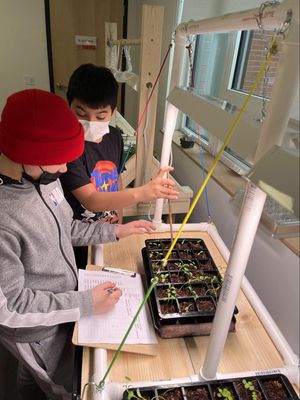
Two boys with seedlings
Courtesy of Andrew Wild

Students measured the heights of their plants each week, and they stopped in during lunch and passing periods to show friends their herbs. The plants were a highlight of family conferences, and several students gave their seedlings to friends who weren’t in our science class.

Student ownership was also a feature of the cooking process in math. Students chose a dumpling recipe, and many selected one from their family’s culture: samosas, momos, potstickers, perogies, and empanadas. One student called her Bosnian grandmother for a family recipe. 
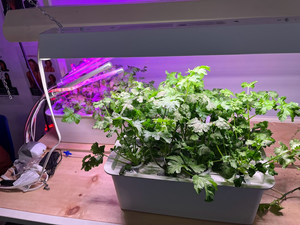
plant
Courtesy of Andrew Wild

Students designed experiments that investigated how manipulating light impacted the growth of parsley, basil, and cilantro.

An incidental benefit was changing the ambience of the learning environment from the purple lights, gigantic herbs, and sinuous root systems. Students got their hands dirty when planting seeds, measuring plant growth, and carefully cutting the plants.

Our rooms were filled with the smells of herbs as they grew and when students chopped them to prepare for cooking. And of course, we enjoyed the delicious aromas and flavors of dumplings. 

A CELEBRATION OF DIVERSITY AND COMMUNITY

Author and journalist Michael Pollan once said, “Food is not just fuel. Food is about community, food is about identity. And we nourish all those things when we eat well.” Pollan’s words beautifully capture our experiences in this project. Family members came in to help cook. Our students learned about and enjoyed foods from each other’s cultures, which enabled the deepening and extension of connections among students and adults. 
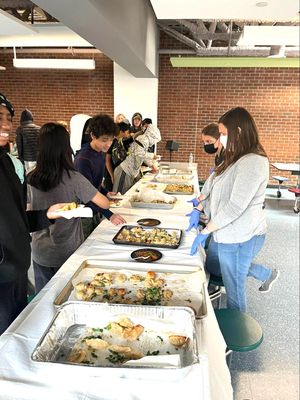
Students eating
Courtesy of Andrew Wild

Even if schools don’t have a great deal of cultural diversity, foods (especially dumplings!) can be an entry point for learning about different cultures and building community. 

Further enhancing the connections among our community members, our school district’s cultural liaisons were judges and taste testers at a culminating event where we also sampled all of the dumplings.

The winning group made vegetarian Nepali momos and received a cabbage as the winning trophy. When a chant of “Eat it! Eat it!” ensued, a beloved student took a bite out of the raw vegetable on behalf of the winning team, causing the whole crowd to erupt into fits of laughter.

RIGOR 

All of our dumplings were vegetarian, but we made sure the “meat” of standards-aligned math and science content and skills were centered in the project, which meshes with author and national education consultant Zaretta Hammond’s conceptualization of culturally responsive teaching. Specifically, we sought to (in Hammond’s words) “improv[e] the learning capacity of diverse students who have been marginalized educationally.”

Students measured the heights of their plants each week. In math, they calculated the mean, median, and mode of these measurements and then “handed them back” to science class, where patterns were analyzed and growth of herbs under different conditions was compared.

With each week, students improved their analytical skills and developed greater independence as scientists, mathematicians, and chefs. Dumpling recipes were reviewed for ratios to produce the best flavors. Costs for ingredients were calculated using unit rates, and each dumpling had a unit price.

REFLECTION

To finish the project, our students completed a reflection similar to KQED’s Engineering for Good curriculum. Zulie wrote that the project was “soooooo cool. It inspired me to be an environmentalist.”

Whatever students’ feelings about the Great International Dumpling Challenge, we doubt they will forget the towering fragrant herbs, the delicious multicultural food, and the sense of community and connection. We look forward to improving the project this year and extending the integration of disciplinary perspectives to English and social studies.


20 Classroom Setups that Promote Thinking


20 Classroom Setups that Promote Thinking

Can how you set up your classroom impact how people think?  

 From: https://www.teachthought.com/pedagogy/classroom-setups-that-promote-thinking/?fbclid=IwAR2B0dUrPHLZJTodoG5jCg1RR8xQRXzydCLIhjW5Pd0jBe4h2DuMWZnZ4CI

If you design learning with physical space and interaction in mind, it absolutely can.

Desks are a staple of the ‘modern’ classroom as we know it. Usually, these learning spaces are simple, and simply arranged: places for students to sit and read and write, lined up neatly in rows. While progress has been in the design of schools and classrooms, it’s usually only in pockets of well-funded ‘future schools’ with very little application for the rest of us.

So what can we do? That’s the point of this post. If you think of the following ideas as exactly that–ideas–then you’ll realize that none of these are either good nor bad. They’re ideas. If they are used well to solve a problem or promote a characteristic, they are being used well; if they don’t, they’re not. Many of these aren’t immediately reproducible in your own classroom. They may not work for your grade level or furniture or budget or content area. But you can take it as an idea, learn from it, and use it (or not) accordingly.

So, the bit about ‘classroom setups impacting thinking.’ Learning is an ecology. Classroom design impacts classroom management impacts curriculum needs impacts lesson and unit design impacts teacher personality impacts technology needs impacts literacy strategies and teaching strategies, and so on. Each one of these possibilities will only work as well as you are able to adapt the way you plan instruction and design learning experiences. Yes, you can design a classroom using a Fishbowl approach–and not just to host a Fishbowl discussion, but for longer periods of time.

You can also set up a ‘Google Room’ or ‘Maker Space’ and not promote thinking at all, or have students performing stunning cognitive acrobatics sitting by themselves on a cold floor. The idea here is that new ways to set up your classroom can help you think differently about how and why you use certain arrangements, and then design more intentionally moving forward (even if you just stick to plain ol’ rows).

In fact, if you think of rows and rows of desks as having pros and cons, causes and effects, you’ll see that these rows lend themselves well to certain things (organization, paper passing, etc.), while not so well to others (collaboration, movement). You’ve already (perhaps unwittingly) adapted your instruction to whatever design you normally use. You plan with it in mind. If you take a new approach, you’ll need to design with that in mind as well. And that’s where the actions and behaviors that promote thinking–interaction, movement, study, making, collaboration, thinking alone, and so on–become a factor.

Note, we’ve placed an asterisk* beside those approaches that are more strongly suited to ‘thought’ than others. With that preface, on to some of the possibilities (there are many more!).

20 Ways To Setup A Classroom To Help Your Students Think

1. Maker Spaces

makerfestivaltoronto-fi

How this is structured depends on your space, content area, grade level, etc. But any content area can use ‘making’ as a primary teaching and learning strategy, and to do so, you’ll need to create the spaces for that to happen. A mix of the ‘Learning Labs’ approach and the ‘Google Room’ may work well.

2. Geometric Mix

geometric mix

This approach takes a mix of forms–rows, groups, semi-circled tables. While the furniture in the pic above may be beyond your reach, you can produce a similar effect with a combination of tables and desks.

3. Differentiation Stations*

This is physical grouping, but based on areas of differentiation–background knowledge, reading level, an individual skill, etc. If instruction is tailored for a student in this way–with their Zone of Proximal development–there is more opportunity for thinking, teaching, and learning that ‘fits.’

4. Fishbowl*

Also a teaching strategy, Fishbowls sees a group of students in the middle, and a group on the outside in a circle facing the group in the middle. You can also arrange your classroom this way permanently–or at least for an extended period of time. The ‘fish’ in the middle have one function (e.g., reading roles from a play, solving a problem, analyzing art, etc.) while the group on the outside participates in a #backchannel twitter chat with a love running log on a screen. Here, everyone can have a voice–and an opportunity for thought.

5. One Group + 4 Rows

This one is what it sounds like it’d be–one group complemented by 4 rows. This setup could be useful if the majority of the class is often working on one activity–or part of an activity, while the bulk of the class works on something else. It obviously can be used collaboratively as well. 

6. 2 Groups + 2 Rows

beautiful desk furniture

Same as above, but more of the class is in a group this time, so the class is split more evenly.

7. Function Pods*

This one is similar to Differentiation Stations, only the idea here is less about differentiation and more about a task. Think literature circles, for example, where everyone has a role. The difference here is that the whole classroom is set up that way.

8. A ‘Google Room’*

office community

Think colors. Lots of colors. Shapes and textures, too. Diverse lighting sources. A lot of natural light, if possible. Areas to work alone, in pairs, or in groups. Sitting. Standing. Openness. Collaboration. May not be possible to realize completely, but you could use it as inspiration.

9. Two Sides*

You can also split the classroom into ‘two sides.’ This may be comprised of rows, but the room is set up in halves oftentimes facing one another. This can be especially effective for Social Studies classes, or other content areas that use Accountable Talk as a teaching strategy.

You can also have the two sides comprised of angled rows. This isn’t a huge change from traditional rows, but it does offer a few advantages if you’ve got the room, namely that students are in the line of sight of one another more naturally.

10. Giant Oval

Usually, this is used for team-building activities, but it’s possible to run a classroom this way for a full unit if you plan for it effectively. Maybe a steady diet of agree/disagree, debate, Socratic Seminars, and Accountable Talk, for example.

11. Teacher In The Middle

Picture a ‘regular classroom,’ but with the teacher (and their desk, if they have one) in the middle. Changes the dynamic of the classroom quite a bit. Whether that’s an effective teaching tool or not depends on how you use it (the same goes with all of these, I suppose).

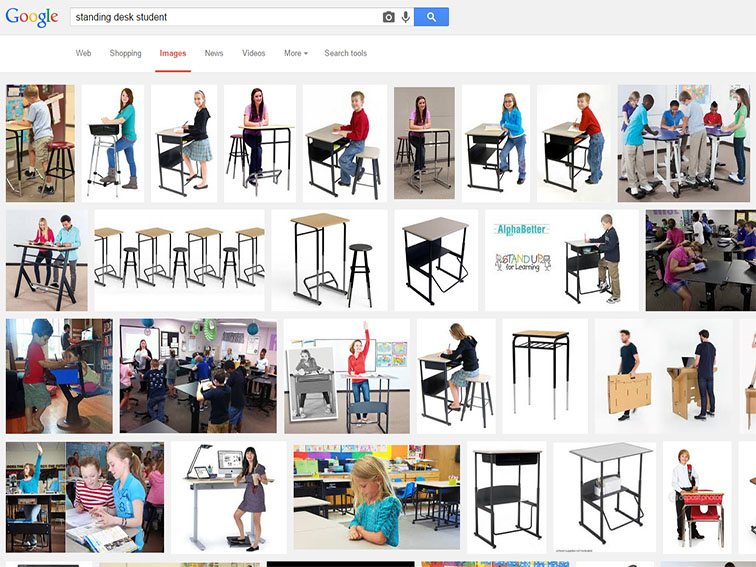
12. Standing Desks

standing desks

They’re out there. Write a grant proposal, put your desk in the middle, and make it work.

13. Horseshoe

An oval with one end missing. Kind of. Not sure this would be very effective long-term, but for a reading activity or a write-around (which are terribly underrated as teaching strategies), it’d work swimmingly.

14. Two Circles

Circles allow students to face one another and encourage conversation. It’s not ideal for small group work, but fordirectn instruction and literacy activities, it has potential. One giant circle may not work well for a daily setup, but two circles might. With two circles, the size is obviously reduced compared to one, giving you a bit more flexibility for classroom management.

15. Rotating Groups*

This is less about the shape of the desks, and more about the workflow and lesson design. The idea here is to plan lessons and units that require students to work together with different groups for different reasons, and to keep them moving, whether within one class, one week, or the unit overall.

16. Middle Circle, Outer Square

Putting a square on the outside and circle on the inside–or even vice-versa–is really just a ‘geometric variation’ of the fishbowl, but the size of the circle can be adapted for daily use by a large cluster of students.

17. Learning Labs*

If you can recall back to the high school science lab–high desks, ‘things’ to tinker with, students standing and moving around small areas of collaborative learning space–that’s the idea of learning labs. This can be used in any content area and any grade level, and doesn’t even necessarily require hands-on manipulatives. Students standing around a high desk solving physics or geometry problems while ‘mixing’ isn’t a management nightmare if you’ve planned a lesson with this approach in mind.

18. A Learning Studio*

This is one example non-traditional classroom setups–imagine a Starbucks mixed with a library mixed with a classroom mixed with a maker space mixed with a design studio. Probably wouldn’t work if you have 35 students, but if you have less than 20, this kind of approach could change the culture of learning in your classroom.

19. Open Square

Similar to #10, this one came on twitter from , “I do an open square with the open side facing the board & I put a table in the middle for my materials.”

20. Fluid

Change your classroom setups weekly. Let the learning goals dictate how you use your space–and how students use their individual spaces. A fixed learning space reflects a fixed mindset. It’s not ‘a lot of work,’ it’s adapting.

20 Ways To Setup A Classroom; 20 Classroom Setups That Promote Thinking; adapted image attribution Google, flickr user makerfestivaltoronto, bsfinhull 


Friday, July 15, 2022

From Truth for Teachers: Twenty-two Classroom Systems that Make My Teaching Easier


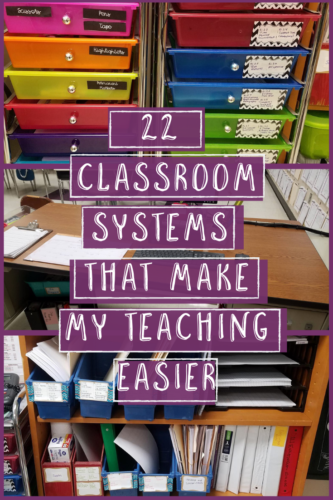
22 classroom systems that make my teaching easier

By Angela Watson

Founder and Writer

https://truthforteachers.com/22-classroom-systems-that-make-my-teaching-easier/?fbclid=IwAR07-FUPwDxIBUOl9wT0nnEcmEZ-hXBLImeoXXUmzUzM1gvV9MzX6RmAOYE 

Twenty-two Classroom Systems that Make My Teaching Easier

My name is Deanna Roberts and I’m a third grade ELA/SS teacher in Ohio. As a lifelong perfectionist and overachiever, the club has helped me achieve a healthier work-life balance and has changed my life for the better. I am much more intentional and productive during work hours thanks to the strategies I’ve learned in the club.


As I’ve been in Angela’s 40 Hour Teacher Workweek Club for a full year now, (and then one year in the graduate program), I would like to post a short reflection of a few things I’ve gained from the club these past two years.

The strategies I’ve gained through the club have allowed me to leave work at work with few exceptions. My firm cut off time is 5:30 pm, which is 2 hours extra beyond contracted hours. (And remember, nothing comes home!)

There are several days each week that I leave work on time. I don’t go in early. I work an average of 50 hours a week.

Here’s how I do it.


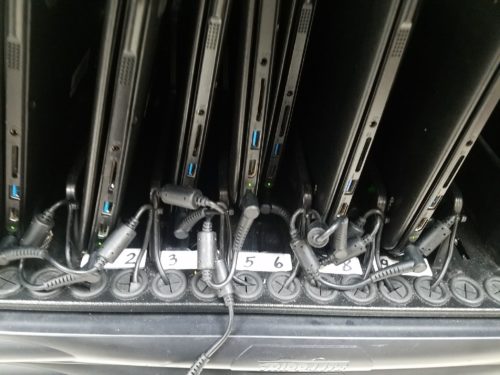
Each Chromebook is numbered and has a corresponding cord in the Chromebook cart. It is their responsibility to plug their Chromebook in the correct slot. We have a Chromebook checker class job. This student makes sure each Chromebook is plugged in at the end of the day.

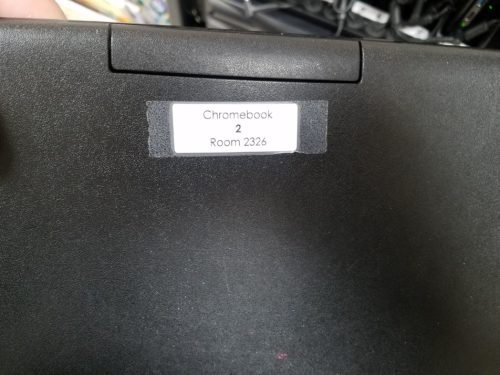
I won’t have to change Chromebook labels every year! I have extra labels if I need to replace any throughout the year. It is a paper sticker label with Scotch tape on top. We use class numbers (alphabetical order) for all kinds of things!

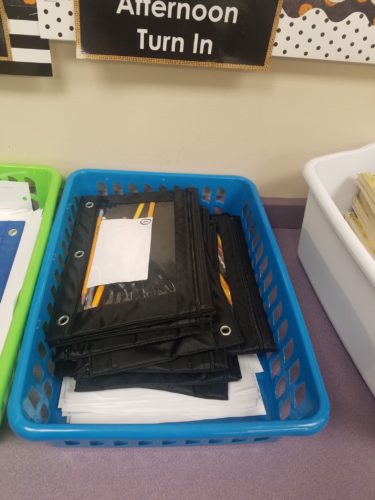
Pencil pouches get turned in every Friday. I give everyone five pencils at the beginning of the year along with a notecard with their number on it. If they have five pencils in the pouch on Friday, they get a sticker or small treat. I switch out pencils that need to be sharpened for new pencils.

We have a pencil sharpener job that a student completes during bus dismissal time each day. No one sharpens pencils during the school day at all. The pencil sharpener person uses the pencils they sharpened during the week to fill up the pencil pouches on Friday afternoons.

If a student turns in their pouch with less than five pencils, I give them new pencils and they don’t get the sticker. They try again the next week!

The morning class has blue pouches and the afternoon class has black pouches. I bought them 2/$1.00 at Walmart over the summer. I did have a few students who lost their pencil pouches. I gave them a gallon ziplock bag to use as a replacement or allowed them to bring in one from home. This works very well for me and by January it is self-sufficient.

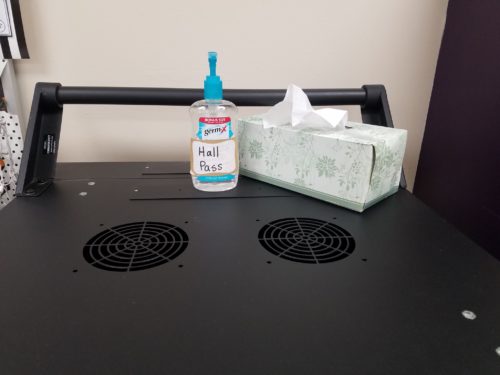
This is one of my favorite things about my classroom! The procedure is that you can use the hall pass if the teacher isn’t talking, and during work time, as long as we are not taking a test. One at a time, place it on your desk until you get back. If you ask the teacher if you can go to the bathroom, the answer is no! Always follow the procedure! Huge timesaver!

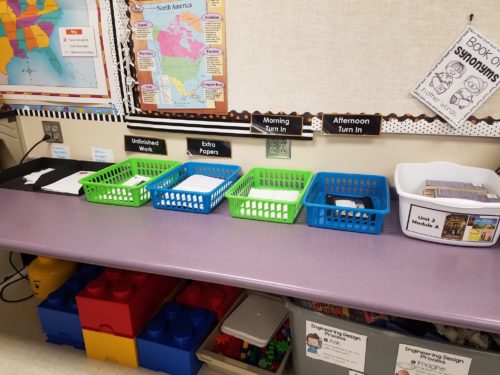
Indoor recess toys are stored under the counter (there is also a cabinet with board games etc.) There are two students whose job is to get the toys out and make sure they are properly put back. The big gray tub is filled with recyclables and building tools with which students are free to create with at one specific table in the room- we have a procedure. The two black trays have well-wisher forms and kindness recorder forms; these are class jobs.

When students are absent the Well-Wisher writes them a letter and puts it in their mailbox. The Kindness Recorder notices kind things and fills out a form to give them or put in their mailbox.

All extra copies go in the extra papers bin and students are free to use them as needed. This is especially helpful for field trip permission slips. The turn in trays are where everything gets turned in. The book bin contains our class set of trade books for the current module.

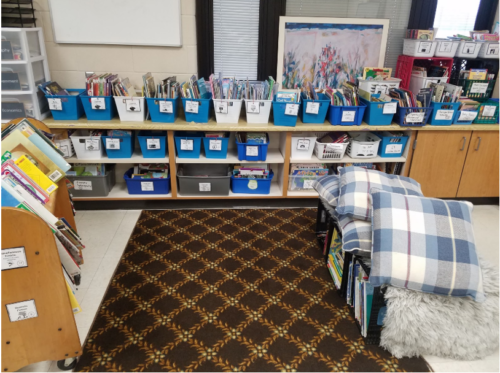
My classroom library books are organized by genre and author. Classroom Librarians (student jobs) keep it in order. Students are free to borrow one book at a time on the honor system. I do NOT even attempt to keep track. Pillows are for bottoms only. They are not allowed to put their heads on them.

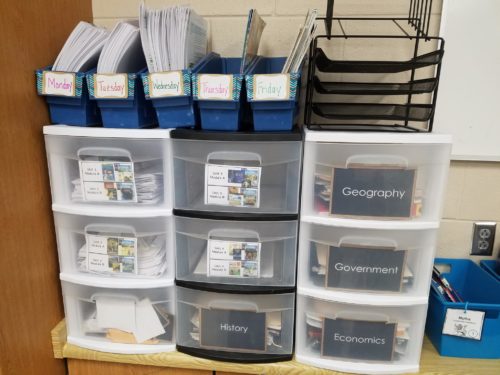
These drawers contain extra resources for each reading unit (extra copies, extensions, etc.) and there is a drawer for each social studies strand. The messy drawer on the bottom has center work that needs to be put back in the correct place. The bins on top are for daily materials. The black organizer currently stores my teacher Chromebook and makeup work that needs to be completed.

I keep blank papers in the trays: copy, handwriting, and notebook paper. The top tray is papers to be graded. The blue binder on the bottom shelf lying sideways is my “Why” binder- I keep the mementos the kids give me in binder sleeves after I take them off the wall.

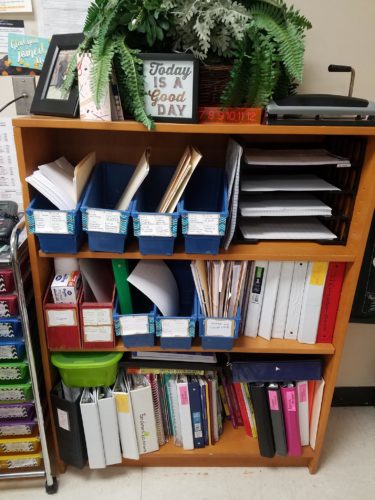
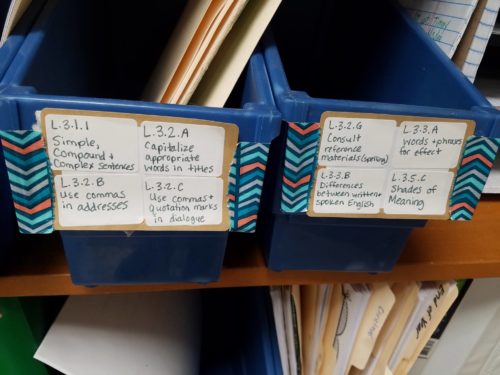
All language and speaking and listening standards have a bin on the bookshelf behind my desk. I put all of my spelling resources in a file drawer in my desk, labeled with the week.

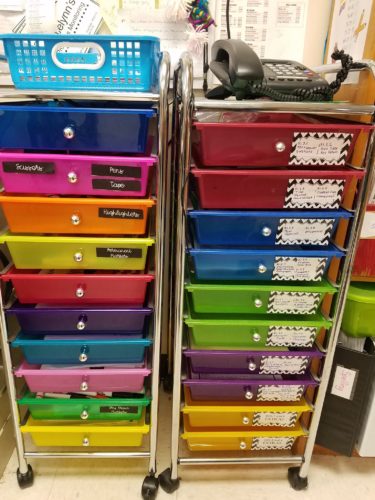
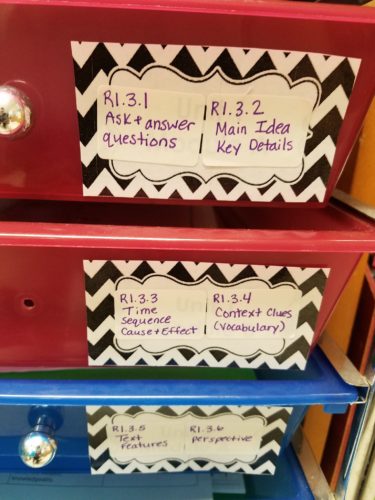
On the right are my drawers labeled with each reading standard. On the left are drawers with supplies and other needed materials. The not-yet labeled drawers contain the current vocabulary unit work, cursive handwriting, my sub folders and emergency medicals, Book-it and PBIS materials, and test prep materials. The blue bin on top is for copies that I haven’t put away yet and things that people bring me that need to be sorted.

I have a drawer for every reading standard. I put example projects, graphic organizers, and anything else that goes along with a specific standard in the corresponding drawer. This is right beside my desk.

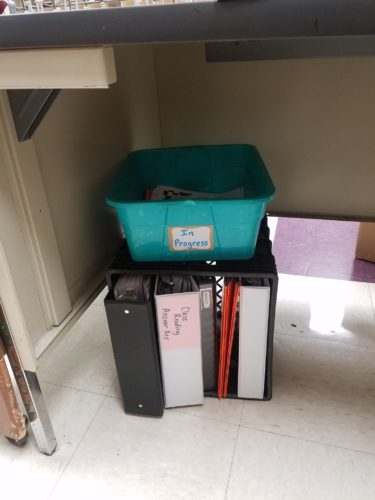
Under the “In Progress” bin are some resources I use weekly and my meeting notes binder that I take with me to all meetings. I used to keep my sub folder and emergency medicals there, but I keep them in a drawer organizer beside my desk now.

The “In Progress” bin is where I put whatever project I am currently working on. I also put homework in here that just needs to be checked off. It is handy for when I have just a few minutes- I can choose from the more involved tasks that need to be finished or the homework that just needs to be checked off.

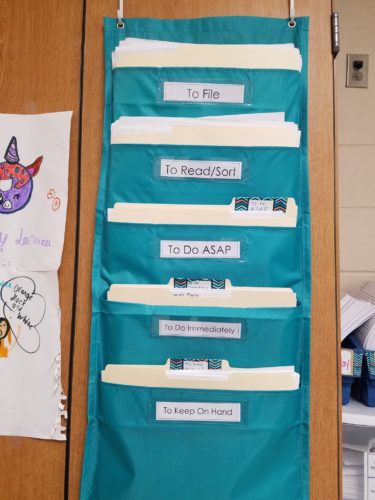
This hangs right behind my desk. This is one of my favorite outtakes from the club! It keeps the clutter off my desk and it is easy to go back to what I need!

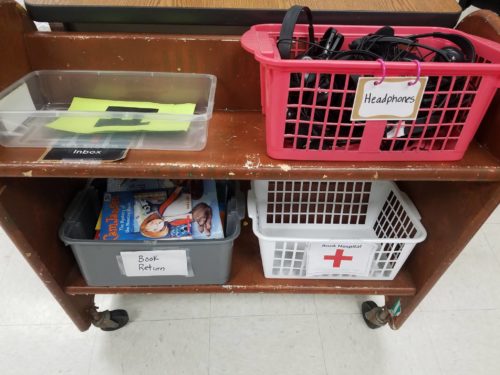
My inbox, extra headphones, book return, and book hospital. The book return is managed by my classroom librarians (student job). The inbox is for tardy slips, notes from home, field trip money, and any other things students might need to turn in besides homework or classwork.

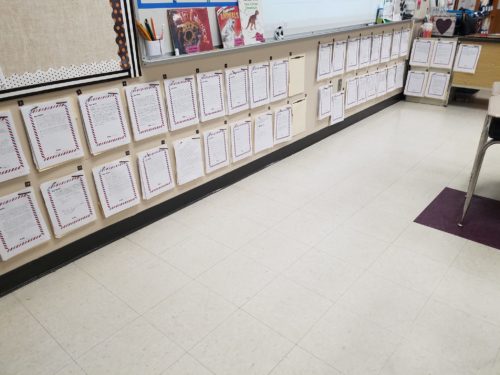
These are student maintained portfolios with monthly writing samples- other assessments go in a filing cabinet in a big pile, to be filed, eventually…

Next year, I might put the portfolios on the bulletin board in the back of my room instead. This is a high traffic area and I had a problem with papers getting torn off accidentally.

You might notice the small soccer ball on my whiteboard tray: it is an ice pack from Dollar Tree. I put it in a small ziplock bag when I hand it out and sanitize after each use. I keep several in my classroom freezer. It is essential! I also stay in supply of mints and bandaids. This saves many nurse trips!

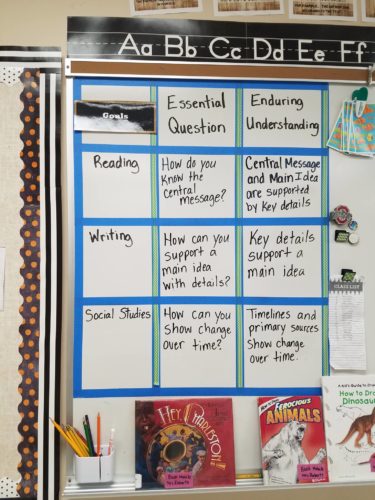
This is how I display my goals each week. We are required to show our learning targets and for our students to be able to repeat them when asked.

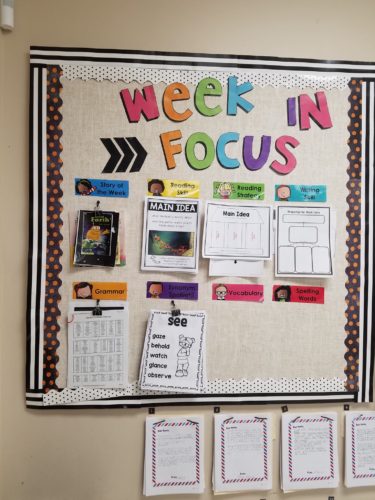
This is right inside my doorway. The most frequently referenced items are the two that are currently missing; which are taken down on Fridays. These are the spelling list and vocabulary words and definitions. The rest of it is more for me than them, but I think they occasionally reference it.

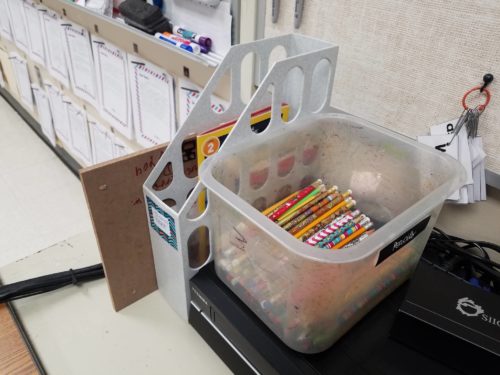
The Pencil Sharpeners (class job) place all sharpened pencils here. There is another place for pencils that need sharpened. I use these pencils to refill pencil pouches and students are allowed to take them freely throughout the week. They will usually trade out a pencil that needs to be sharpened pencil for a sharp one if they need it. Our pencil problem is non-existent. Beside the pencils is the place where I put things that need to go to other places- the office, the speech teacher, library, etc. On the other side of the pencils is the pencil sharpener. Only the pencil sharpener person is allowed to use the sharpener.

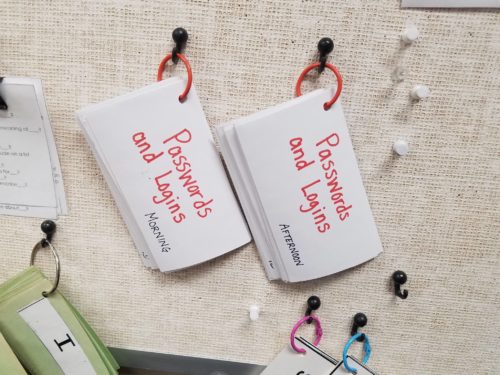
I keep these handy right beside my desk. The cards are numbered so it is easy to find each student’s information. I also print out the class lists of passwords and keep them in my “To Keep on Hand” folder.

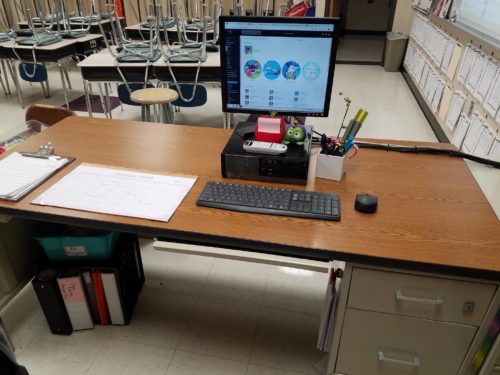
Clean desk club! Also, underneath my desk, you can see class lists hanging by a magnet clip. I use the lists for everything! Field trip money, assignments turned in, reading goals met, etc. It is very easy to get a new list when I need one.

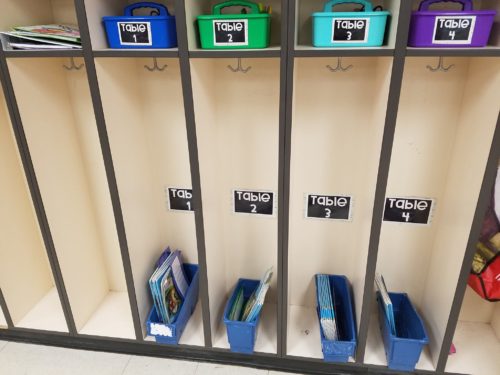
The small numbered bins on the top contain crayons, scissors, and glue sticks. The bottom bins contain our basal readers. The books are marked with duct tape (over contact paper) to correspond with the colored bins.

Glue sticks and scissors are also color coordinated. We have a table supply manager who distributes these supplies when we need them and puts them back when we are finished. (One day I will get around to labeling the book bins–maybe!)

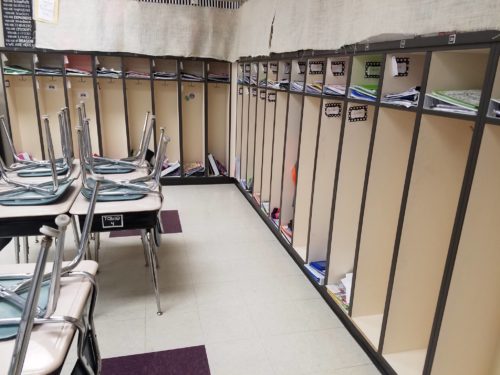
Cubbies are numbered, with paper name tags (not laminated!) placed inside that students can choose to keep or not. The top cubby is for my afternoon class and the bottom is for my homeroom. Students keep their Fruit Binder (binder with all of their folders and their Plickers card; it is called this because I put a smelly fruit sticker on their Plickers card), their writing notebook, pencil pouch and vocabulary journal in their cubby.

It is a classroom job to check cubbies before anyone leaves the classroom. They may look a little messy, but we literally never have loose papers on the floor. Everything has a place! Desks are turned around backwards, they do not use their desks for storage. All loose/returned work goes directly in their take-home folder.

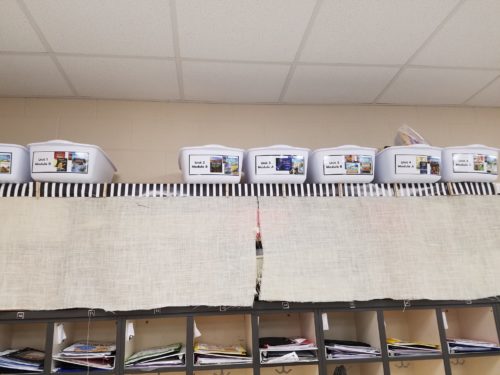
I store classroom sets of trade books for our reading program on top of the cubbies. These are dishwashing bins from Walmart. Each bin is labeled with the unit and module. This is the only thing that I keep above the cubbies. I take each bin down as I need it and place it on the back counter. We keep the bin on the counter for as long as we need the books for the module.

I have storage shelves behind the fabric where I keep extra paper towels, tissues, etc., seasonal decorations and supplies, games, and other materials.

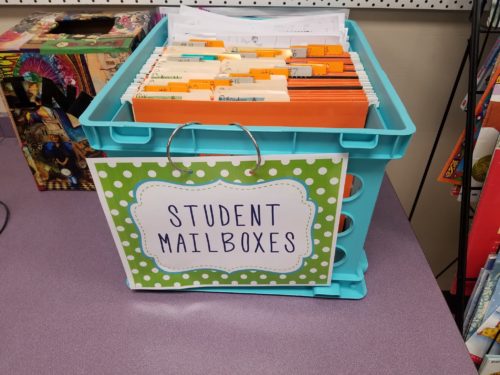
Papers to be distributed are in the last file folder in the back. This is a classroom job. Students pass out papers every week. If someone is absent, their work goes in their mailbox.

Beside the mailboxes is the “I Need” box our art teacher made for me! This has saved me many headaches as students write me notes letting me know people are bothering them, they need supplies, etc. and I can be proactive. It is also a classroom job to check the “I Need” box every day and bring me the notes.

A place for everything and everything in its place!

Some of my favorite takeaways from the club that are not pictured are batching, stamps and grading stations. These are all huge timesavers and totally worth it!

I would also like to mention that a huge contribution to my success is that 90% of my assessments, including spelling tests and bi-weekly vocabulary tests are on Google forms, Edulastic, Readworks, or on our ReadyGen interface. They are all graded automatically except for extended responses. I love, love, love the 40 Hour Workweek Club!

Deanna implemented these systems after joining

the 40 Hour Teacher Workweek Club.

This can be the year YOU get your systems in place, too.

https://join.40htw.com/full-year