Thursday, September 10, 2020

Safely Using Videos in the Classroom

From:  https://brownbagteacher.com/safely-using-videos-internet-in/?fbclid=IwAR14om4QHPSgt0TALyItmCN2QWMxF3xN09d8vg3V_h40LnfQEkSiMwTuoM4

SAFELY USING VIDEOS IN THE CLASSROOM

From Brown Bag Teacher Blog

So, you’ve found the perfect Science Kids video to launch your writing unit or a just-right song to review that phonics skill, you hit play on the video and allofasudden you see Hedi Klum’s body in a bikini rolling on a beach, a man taking a little blue pill to “get in the game” and YOU DIE. Your mind starts panicking and you jump in front of the projector only to realize your body is now projecting an ad for the morning-after pill. Your brain can’t work fast enough, and you hang your head in shame. Rookie mistake, you tell yourself; I SHOULD HAVE KNOWN BETTER. You tell your colleagues and they start taking bets about how many parent emails you are going to receive. 
Sound familiar?! Today I’m sharing with you 3 free resources for circumventing the internet-cycle-of-shame and protecting your friends from things that you don’t want to talk to a 6-year old about! Protect students from pop-ups and ads when using technology. These 3 FREE online resources are perfect for the primary student.
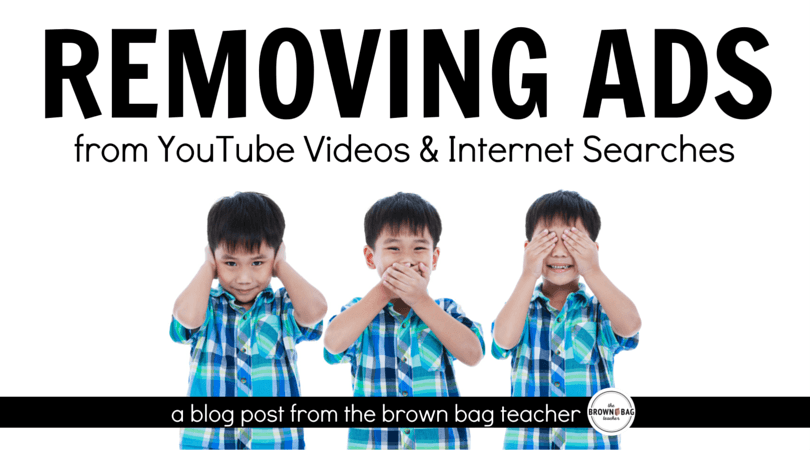
ELIMINATE YOUTUBE ADS INSTANTLY 

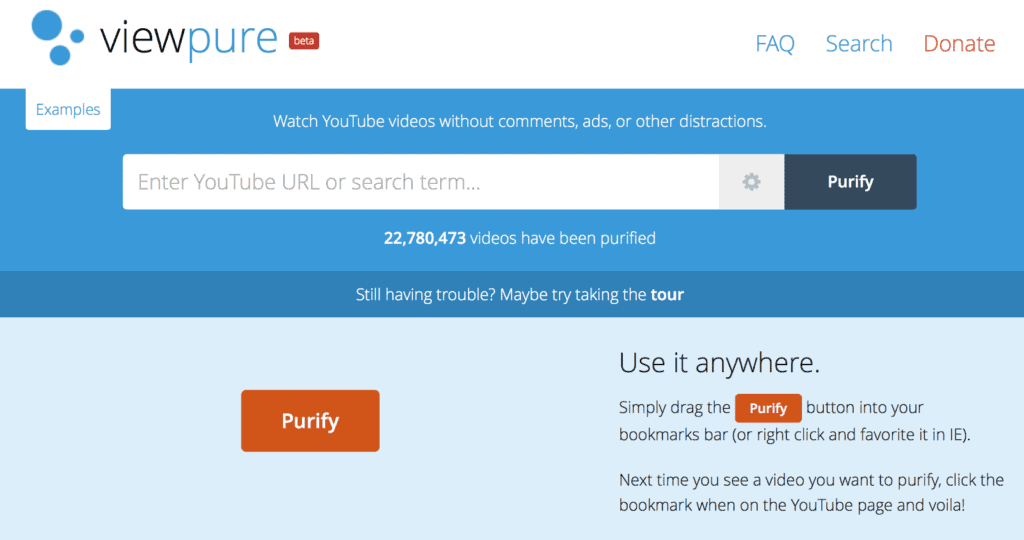
ViewPure has quickly become my go-to resource for putting YouTube videos onto a blank surface – no ads, no pop-up videos, no automatically playing videos after your video wraps-up…NOTHING! Plus, there is no copying of links involved. Rather, you drag and drop the orange little button you see below to your Internet Dashboard/Favorites/Bookmarks. Then, when you are on YouTube and need to purify a video, you just press Purify and the video opens in a new white window. Boom – 2 seconds and you’re done!

YOUTUBE ADS – ROUND TWO

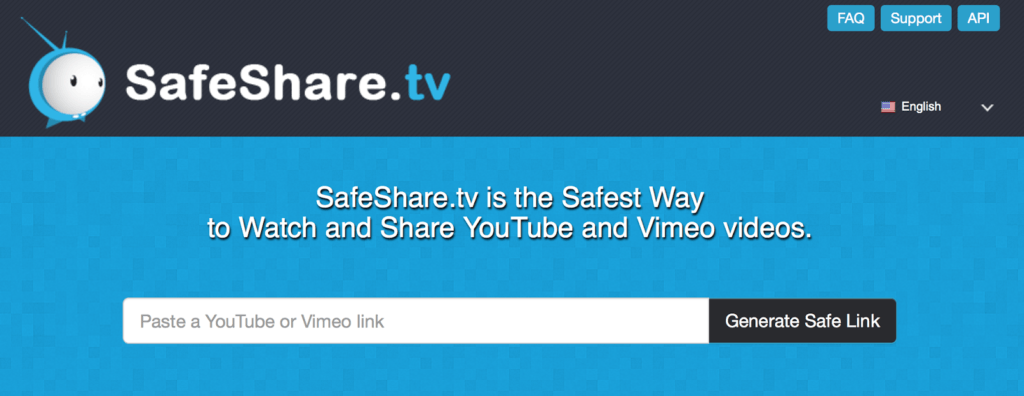
Similar to Purify, ShareShare.tv allows individuals to eliminate both the side-ads and automatically playing videos after your video. SafeShare does require users to copy-and-paste their YouTube link into their website, then a safe link generates. An added feature Purify doesn’t have is that you can choose the caption/name of the video (and description) that shows up when the video is played.

ELIMINATING WEBSITE ADS

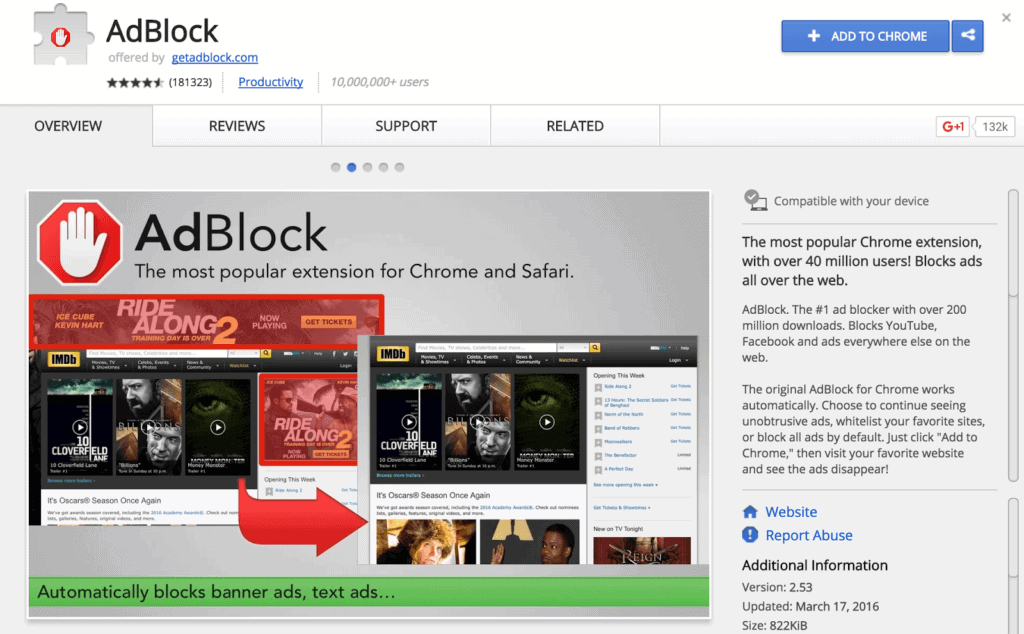
Ad Block is a fabulous app (it’s a Chrome extension, as well as, an app for mobile devices) that automatically removes website and search ads. All you do is install and it starts working. You know it’s working because a Red Stop Sign shows up with a small number. The small number tells you how many ads were blocked.

This is a great resource to install on computers where students might be doing research or anything on the Internet. When using it for National Geographic Kids, 7 ads were block. Using Discovery Kids, 3 ads were blocked. While the ads might not have been objectionable, they are still a distraction and a temptations for young learners. This is an AWESOME extension that helps keep our friends focused and it’s completely free within Google Chrome.

So, friends – take the next 5 minutes and explore these resources. Save yourself the internet-cycle-of-shame and the awkward parent emails. These are 3 websites I routinely use in our classroom and the best part is that they are free and easy. Do you have any other go-to websites for blocking and eliminating and cleaning internet links? If so, I’ve love to hear your ideas! 


Teaching Tolerance: Authors of Their Own Stories

https://www.tolerance.org/magazine/fall-2019/authors-of-their-own-stories?fbclid=IwAR14om4QHPSgt0TALyItmCN2QWMxF3xN09d8vg3V_h40LnfQEkSiMwTuoM4


MAGAZINE FEATURE

Authors of Their Own Stories

When these students wanted to see themselves in the books they read, their educators helped them do something about it.
https://www.tolerance.org/magazine/fall-2019/authors-of-their-own-stories?fbclid=IwAR14om4QHPSgt0TALyItmCN2QWMxF3xN09d8vg3V_h40LnfQEkSiMwTuoM4
PHOTOGRAPHY BY LIBBY MARCH

When children’s author Vanessa Brantley-Newton spoke about seeing her identity reflected in literature for the first time, her audience nodded in knowing agreement. Brantley-Newton was addressing elementary students at Tapestry Charter School in Buffalo, New York, as part of the school’s project “I Am the Author of My Own Story” and a Teaching Tolerance Educator Grant.

Brantley-Newton described how, as a young person reading the classic picture book The Snowy Day, she felt a profound sense of validation and belonging. She eventually decided to pursue writing and illustrating children’s books full time. A simple moment of recognition had set the course of her entire career.

Among the listeners that day was Leah White. A parent and teaching partner at Tapestry, she had come to learn more about representation in children’s literature. For White, the issue was personal. “It is very hard for us to find books that relate to our situation,” she says. Dontae, an 11-year-old Tapestry student, is White’s cousin. White’s mother was raising Dontae, but when she passed away in 2017, he came to live with White. She now has full custody as his legal caregiver.

“We talk about unique families, how there aren’t a lot of books in the world about them,” she says. “It would be really nice to pick up a book and show Dontae that even though our family is different, what brings us together is that we love each other. A lot of times our kids aren’t seeing these things.”

White wasn’t the only adult at Tapestry considering the role of representation. As a reading specialist, TT grantee Kaylan Lelito watched the stories that had long been taught at Tapestry fall flat with her students.

“When I worked with students from different backgrounds,” Lelito explains, “often they would say when we were reading with them that they weren’t really interested in the books, that they didn’t see themselves.” Students of color comprise 74 percent of Tapestry classrooms, but in an inventory of their shared book room, Lelito found that only 17 percent of guided reading texts contained one or more characters of color.

To further explore this dissonance, Lelito surveyed her students to find out more about their reading experiences. The results were unsettling: Roughly half of her students didn’t see themselves reflected in the stories they read. Forty-four percent said they never found books about a neighborhood like theirs, and 40 percent said they never found books featuring families like theirs.

National statistics tell a similar story. While more than 50 percent of students in U.S. schools are children of color, only 13 percent of children’s books from the last 24 years contain “multicultural characters, storylines or settings,” according to a 2018 study conducted by the Cooperative Children’s Book Center (CCBC). When the organization studied books published in 2018, they found more animal or nonhuman characters than people of color.

And these numbers only measure the presence or absence of representation—they don’t evaluate the quality of books that feature characters with underrepresented identities. “Just because you have 300 books about African Americans,” CCBC Director KT Horning says, “doesn’t mean all 300 of those are books you would recommend.”

For Lelito, the surveys of Tapestry students confirmed her suspicion: Students didn’t see themselves in the stories they read. And, because of this invisibility, they couldn’t relate. “The stories,” she recalls, “weren’t impactful for them. We wanted to find more books our students could see themselves in, and we were having difficulties doing that.”

With the help of her TT grant, Lelito ordered a wide selection of books from the children’s literature publisher Lee & Low Books, focusing on texts featuring characters with underrepresented identities. But Lelito didn’t just want to make better texts available to students—she also wanted to create space for them to tell their own stories.

After distributing the new books to third-, fourth- and fifth-grade classrooms and the library, Lelito turned to Tapestry’s librarian, Jennifer Chapman, for the second part of the project. Chapman worked with students to explore concepts like voice, flow and the sequence of storytelling. Then she had them create their own stories, with characters modeled after their own lives. “How does this reflect you?” she asked them.

A lot of kids would like to see books about families that are like them. If [every book] has the same storyline … they could feel invisible.

Writing their own stories resonated particularly well with older elementary students, who Chapman says were developmentally best prepared to process the project’s significance. “The youngest of our readers, they’re just excited about getting a book,” she says. But as kids age, they begin to pick up on the nuances of socialization and difference. “At about third grade,” Chapman explains, “a little switch happens. They start to spend more time actively looking for books that better reflect their lives.”

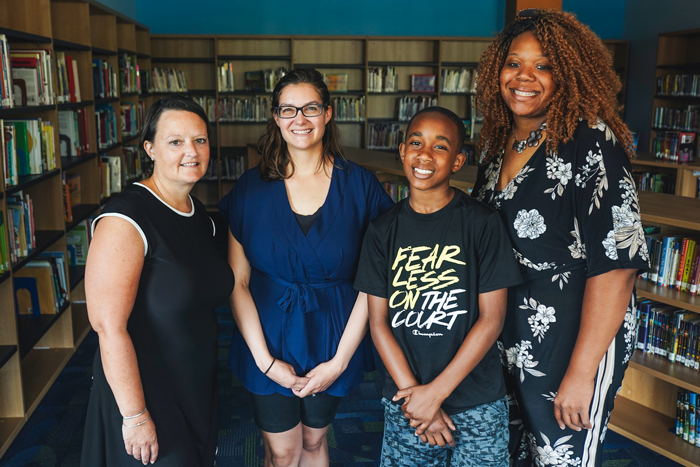
Kaylan Lelito, librarian Jennifer Chapman, Dontae White and Leah White standing together between shelves filled with books in a library.
Kaylan Lelito worked with librarian Jennifer Chapman to acquire and create books that reflect families like Dontae and Leah White's family.

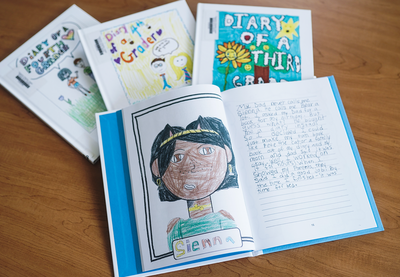
Once students finished their stories, Chapman and Lelito sent them off to a publisher, where they were anthologized in three collections. At a school community meeting, the stories were shared with family and friends. Third-graders titled their book Diary of a Third Grader; fourth- and fifth-graders followed suit. This fall, copies of the texts will be made available for checkout in the library, as well as in all classrooms.

For the final step in the project, students wrote persuasive letters to major children’s book publishers, articulating their need for characters and storylines that better reflect their experiences. “As educators of a very diverse population,” Lelito reflects, “it is incredibly important for us to help students realize that even at a very young age, they can have some control over how they are represented in the world around them.”

I don’t get to read about people like me.

“Dear Scholastic,” one third-grader wrote, “I’m just a kid, and I have a different heritage. I’m Muslim, and I don’t get to read about people like me. Other people should get a chance to read about different people, too. To me, learning something new about others makes me feel like I can connect with them and understand them.”

Another student’s letter articulated the problem that led to the project in the first place. “When someone reads a book,” he wrote, “they should be able to say, ‘Hey! That person looks like me!’ instead of reading a book and feeling bad about themselves because they look different. ...

So I suggest that you write some more diverse books.”

Ehrenhalt is the school-based programming and grants manager at Teaching Tolerance.


Dear Parents: We Need Another Word, Because This Is Not Homeschooling (WeAreTeachers)


Posted by Joanna Breault

Joanna is an editor at WeAreTeachers.

https://www.weareteachers.com/online-school-is-not-homeschooling/?utm_content=1599681665&utm_medium=social&utm_source=facebook&fbclid=IwAR14om4QHPSgt0TALyItmCN2QWMxF3xN09d8vg3V_h40LnfQEkSiMwTuoM4

Dear Parents: We Need Another Word, Because This is Not Homeschooling

And calling it that is a slap to the real heroes.

Online school is not homeschooling

It’s one of those things people say now, with a rueful smile and a shrug … “Guess we’re all homeschoolers now, right?” Except no. No, we are not, and here’s why. Online school is not homeschooling. And using the word “homeschooling” for what parents are doing right now devalues the efforts of the people who are actually educating them.

Homeschooling is a thing; it’s just not this thing

Due to the pandemic, millions of children are learning remotely. But some families have chosen to teach their kids at home for years. Here’s a basic definition: Homeschooling is the educating of children at home by their parents. So while lots of kids are home, the vast majority of them are still being educated by their teachers. 

The term that erases teachers

If we say we are “homeschooling” when someone else actually holds responsibility for our kids’ daily learning, we are essentially erasing that person’s importance. It’s as cringe-worthy as listening to a dad talk about labor and delivery as if he were the main actor. Of course, the whole ordeal was stressful and time-consuming for him. Hopefully, he was present, supportive, and helpful. But he didn’t push out that baby. Parents, if we are not choosing curriculum, writing lessons, creating schedules, delivering instruction, and assessing learning, we are not “pushing out that baby.” Our efforts are so very important. But please, let’s not take the spotlight by calling ourselves homeschoolers. 

Everything we’re not doing

Thanks to teachers, I’m not worrying about what my kids are covering next week or next month; I don’t have to hold the big picture in my mind at all. I’m not thinking about the milestones that need to be hit between now and next quarter. And I don’t have to be “on” for my kids every moment, answering questions and coming up with another way to say something so that a concept clicks. At the end of the day, I have the luxury of knowing that my kids’ education is in other, capable hands.

But this is crazy and hard

Yes. Virtual education is stretching us in a hundred ways. We’re navigating broken links and confusing platforms. Our big kids have been sleeping until 11:00, our little kids are Zoom-averse, and they all just want to be with their friends in person. We’re trying to work and provide academic help at the same time. So sure—let’s call this something. We’re online learning coordinators. We’re virtual education supervisors, heroically staving off chaos. But friends, we are not homeschooling. 

The real heroes

Teachers, thank you for schooling my children. In my home. Through their screens. Thank you for dealing with technology headaches times a hundred. Thank you for learning their names and throwing all your creative energy into their success. I will support you in every way I possibly can. Choosing my words carefully is the least I can do.

We’d love to hear! How do you feel about the term “homeschooling” in this context? Come and share in our WeAreTeachers HELPLINE group on Facebook.

Plus,10 pandemic parent problems and how to handle them.

Posted by Joanna Breault

Joanna is an editor at WeAreTeachers. She has five kids, homeschooled them for a decade, and (out of an abundance of gratitude) loves working on resources for teachers. She also has a soft spot for long books, strong tea, and public radio.

Leave a reply